You are legally permitted to possess firearms. But every time you attempt a purchase, the same thing happens: NICS delays the transaction, the dealer cannot tell you why, and you wait while the FBI tries to distinguish you from a record that may not even belong to you.
Sometimes the transaction eventually proceeds. Then the entire problem happens again during your next purchase.
The FBI’s Voluntary Appeal File, commonly called the VAF, was created for problems like these. An approved applicant receives a unique identification number—widely known as a UPIN—that gives NICS access to information retained in the applicant’s Voluntary Appeal File during future background checks.
The FBI’s current materials refer to this identifier as a VAF Unique Personal Identification Number, or VPIN. Many firearm owners, dealers, attorneys, and earlier government materials continue to call it a UPIN. Both terms refer to the unique number issued after approval for entry into the VAF.
A properly supported VAF application can help NICS distinguish you from another person, locate documents resolving a confusing record, and reduce the risk of repeated extended delays or erroneous denials.
But a UPIN does not restore firearm rights, erase a criminal record, bypass a background check, or guarantee a “proceed” response.
National Security Law Firm helps clients nationwide determine whether the VAF is the right solution, obtain the required fingerprints and records, prepare the application, and address the underlying NICS or criminal-history problem.
Schedule a confidential consultation with our VAF and UPIN lawyers or call (202) 600-4996.
What Is the Voluntary Appeal File?
The FBI Voluntary Appeal File allows NICS to retain identifying information and supporting documents that would ordinarily be unavailable during a future firearm background check.
The program exists partly because NICS must purge identifying information associated with many “proceed” transactions shortly after notifying the federal firearms licensee. When a person is repeatedly matched to the same potentially prohibiting record, NICS may have to conduct substantially the same research during every transaction.
The VAF allows the FBI to retain information that may help resolve that recurring question.
Examples of information retained in a VAF may include:
- Fingerprints distinguishing the applicant from another person;
- Certified court dispositions;
- Records showing that a charge was dismissed;
- Documentation showing that a conviction was expunged or set aside;
- A pardon warrant;
- Evidence of restoration of civil rights;
- A corrected criminal-history record;
- Documentation concerning an expired protection order;
- Records resolving a mental-health reporting question;
- Military records;
- Immigration-status documentation; or
- Other information establishing that the applicant is not prohibited.
Once the application is approved, the FBI issues the applicant a unique identification number for future NICS transactions.
What Is a UPIN or VPIN?
The term UPIN traditionally means Unique Personal Identification Number.
The FBI’s current VAF materials use the term VPIN, meaning VAF Unique Personal Identification Number. The number connects a future NICS check to information the FBI is permitted to retain in the applicant’s Voluntary Appeal File.
During a future firearm transaction, the applicant provides the number to the federal firearms licensee for inclusion on ATF Form 4473. The dealer then submits it as part of the NICS check.
The number may help NICS:
- Confirm that the purchaser is the person enrolled in the VAF;
- Compare the purchaser’s identity with retained fingerprints;
- Locate documents addressing a recurring record question;
- Distinguish the applicant from a prohibited person with similar biographical information; and
- Avoid repeating research that has already resolved the same issue.
A UPIN is not a firearm license, permit, or restoration order. It is an identification tool used during a new background check.
Who Is a Good Candidate for a VAF and UPIN?
The VAF is designed primarily for people who believe they are legally permitted to receive and possess firearms but experience repeated extended delays or erroneous denials.
A strong VAF candidate may be someone who:
- Is repeatedly delayed during firearm purchases;
- Has been wrongfully denied and later had the denial overturned;
- Shares a name or date of birth with a prohibited person;
- Has fingerprints proving that a matched record belongs to someone else;
- Was a victim of identity theft;
- Has an old arrest with a difficult-to-locate disposition;
- Has a dismissed charge that repeatedly triggers additional research;
- Has an expunged or set-aside conviction that still causes NICS confusion;
- Received a pardon or restoration of rights;
- Has corrected an inaccurate criminal-history record;
- Has a recurring record issue that cannot be permanently changed in the source database;
- Experiences repeated problems because different databases contain inconsistent information; or
- Wants NICS to retain documents that establish lawful eligibility.
The FBI states that a person does not need to have completed a prior NICS background check before applying. For example, a known victim of identity theft may apply before attempting a firearm transaction.
However, the VAF is not intended to excuse a valid firearm prohibition.
Who Is Not a Good Candidate for a VAF?
A VAF application is not the right remedy merely because a person wants to purchase a firearm.
The VAF may not be appropriate when:
- The person is currently prohibited under federal law;
- A state firearm prohibition remains in effect;
- A qualifying court order remains active;
- The applicant has a valid prohibiting conviction;
- The underlying record must first be corrected;
- The applicant needs § 925(c) restoration;
- The applicant needs a pardon, expungement, or civil-rights restoration;
- The issue is a one-time routine delay with no identifiable recurring problem;
- The delay is caused by an enhanced background-check period required by law; or
- The applicant cannot provide fingerprints or the required identifying information.
The FBI may reject a VAF application if it identifies a federal or state firearm prohibition, a court-ordered restriction, or a potential prohibition that cannot be eliminated within the review period.
A VAF rejection does not necessarily mean that the FBI conclusively determined the applicant is prohibited. It may mean the available records did not allow the FBI to resolve the question.
Does a UPIN Restore Firearm Rights?
No.
A UPIN does not restore federal or state firearm rights. It does not nullify a felony conviction, terminate a protection order, remove a mental-health prohibition, change an immigration status, or grant relief under 18 U.S.C. § 925(c).
If you are legally prohibited, the correct remedy may be:
- Federal firearm rights restoration under § 925(c);
- A presidential or gubernatorial pardon;
- Expungement or set-aside relief;
- Restoration of civil rights;
- Mental-health relief from disability;
- Termination of an applicable court order;
- Military-record relief; or
- Another remedy authorized by federal or state law.
A person with a valid federal disability should consult our federal firearm rights restoration lawyers rather than treating a VAF application as a substitute for legal relief.
Does a UPIN Guarantee a “Proceed” Response?
No.
Every future firearm transaction remains subject to a new NICS background check. NICS will continue reviewing federal prohibitions, applicable state restrictions, court orders, and any new information associated with the purchaser.
The FBI expressly states that use of a valid VAF identification number does not guarantee that there will be no delay.
A future check may still be delayed because of:
- High NICS transaction volume;
- Technical or system-connectivity problems;
- A new arrest or potentially prohibiting event;
- New information that was unavailable during the VAF application;
- A change in the purchaser’s state of residence;
- A firearm transaction occurring in a different state;
- A state-law prohibition;
- A newly discovered historical record;
- The dealer’s failure to submit the VAF number; or
- Additional research required by law.
The purpose of the VAF is to reduce repeated extended delays and erroneous denials by giving NICS access to previously retained information. It does not create automatic approval.
What Problems Can a VAF Help Resolve?
The VAF is most useful when the same identity or record question repeatedly interferes with otherwise lawful firearm transactions.
Common examples include:
- Another person’s felony record appearing to match the purchaser;
- A common name and similar date of birth;
- An arrest record without an electronic disposition;
- A record that cannot be permanently updated in the original database;
- An overturned NICS denial;
- An old expungement or restoration order that NICS repeatedly must verify;
- A military record requiring additional review;
- Identity theft;
- Conflicting information among state and federal systems; or
- A record resolved through fingerprints during an earlier challenge.
The application should explain the recurring problem and provide the evidence NICS will need during future checks.
What Information Does a VAF Application Require?
A VAF application requires complete and accurate identifying information.
The application generally asks for:
- Full legal name;
- Any former names or aliases;
- Date of birth;
- Place of birth;
- Sex;
- Race;
- Height and weight;
- Current address;
- Citizenship information;
- Contact information;
- Social Security number, if voluntarily provided;
- Relevant NTN or STN information, if available;
- Information about prior NICS problems;
- Fingerprints; and
- Supporting records.
Providing a Social Security number is not required, but the FBI strongly encourages it—particularly when the applicant has a common name. The FBI states that providing the last four digits is acceptable.
Every identifying field should be reviewed carefully. Inconsistent spellings, omitted former names, or incorrect dates can make it more difficult for the FBI to connect the application to the relevant records.
What Fingerprints Are Required for a VAF Application?
Fingerprints are required.
The application must include a complete fingerprint card or acceptable copy containing rolled and simultaneous impressions.
The fingerprint card must include:
- The applicant’s full name;
- Date of birth;
- The applicant’s signature;
- The originating agency identifier or identifying information for the agency taking the fingerprints; and
- A legible signature from the official who took the fingerprints.
The Social Security number is optional but strongly encouraged. The last four digits are acceptable.
Poor-quality impressions, incomplete fields, missing signatures, or photographs of the fingerprint card can result in rejection.
Fingerprints may generally be taken by:
- A local police department;
- A sheriff’s office;
- Another agency authorized to capture fingerprints; or
- A participating United States Post Office when using the electronic VAF process.
If a local agency captures fingerprints electronically, the applicant must obtain a printed copy for submission unless using an authorized process that transmits them directly.
The FBI does not charge a VAF application fee, although the fingerprinting provider may charge for its service.
What Documents Should Be Included With a VAF Application?
The documents depend on what causes the recurring NICS problem.
Potential supporting evidence includes:
- A certified final disposition;
- A dismissal or acquittal;
- A judgment showing the actual offense of conviction;
- Proof that a charge was reduced;
- An amended judgment;
- An expungement or set-aside order;
- A pardon warrant;
- A civil-rights restoration certificate;
- A record-correction letter;
- An updated FBI Identity History Summary;
- An updated state criminal-history report;
- A prior NICS challenge decision;
- Proof that a protection order expired or was terminated;
- Mental-health relief-from-disability documentation;
- Military court or discharge records;
- Immigration-status records;
- Identity-theft reports;
- Certified identity documents; or
- Correspondence from the agency holding the questioned record.
The FBI may verify submitted documents with the court or agency that originated them.
An application should not be overloaded with unrelated materials. The objective is to give the FBI clear, authoritative evidence resolving the specific identity or record problem.
Should You Correct the Record Before Applying for a VAF?
Usually, an inaccurate source record should be corrected whenever possible.
The VAF can retain documents that help NICS interpret a record, but it does not replace the court, state repository, police agency, military department, or other authority responsible for maintaining the underlying information.
For example:
- A court should report a missing disposition.
- A state repository should correct an incorrectly coded conviction.
- A contributing agency should remove an invalid NICS Indices entry.
- The FBI should update an inaccurate Identity History Summary.
- A military department should correct an erroneous military record.
In some cases, the source record cannot be permanently corrected or cannot be accessed quickly during every NICS transaction. The VAF may then provide a practical way for NICS to retain the documents needed to resolve the issue.
Our FBI firearm record correction lawyers can determine whether correction should occur before, during, or in conjunction with a VAF application.
What Is the Difference Between a VAF Application and a NICS Appeal?
A NICS appeal—or NICS-related challenge—addresses a specific denied firearm transaction.
A VAF application is forward-looking. It asks the FBI to retain identifying information and records that may help during future background checks.
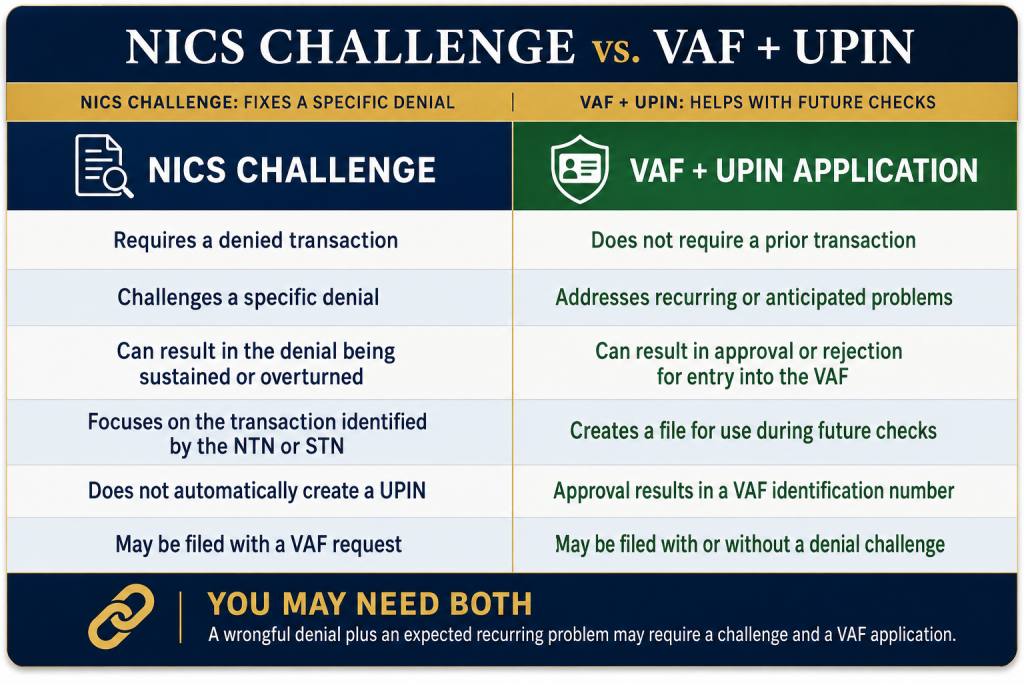
A person who was wrongfully denied and expects the same problem to recur may need both processes.
Our NICS appeal lawyers can challenge the denial while evaluating whether the VAF should be included.
Can You Apply for a VAF and Challenge a NICS Denial at the Same Time?
Yes. The FBI permits a person to submit a VAF request at the same time as a NICS-related challenge.
A combined filing may be appropriate when:
- The present transaction was wrongfully denied;
- The reason for the denial is likely to recur;
- Fingerprints establish mistaken identity;
- The applicant has supporting records that NICS may need during future checks; or
- The same unresolved record has caused several prior delays or denials.
The two requests still serve different purposes. The challenge seeks correction of the current denial. The VAF request seeks retention of identifying and supporting information for future transactions.
How Do You Apply for a VAF and UPIN?
The application can be submitted electronically through the FBI’s eDO portal or by mail.
The electronic process generally includes:
- Registering with an email address.
- Receiving a unique link and PIN.
- Accepting the Privacy Act statement.
- Completing the personal-information fields.
- Uploading supporting documents.
- Providing the required fingerprint card.
- Accepting the applicant acknowledgment.
- Submitting the request.
- Preserving the order number, link, and PIN.
- Monitoring the portal for a decision or request.
Applicants who intend to upload fingerprints or supporting documentation electronically should have the files ready before submitting. The FBI states that additional attachments cannot be uploaded through the portal after the online application is submitted, although materials may later be mailed with the application’s order number.
A complete application can also be mailed to the FBI NICS Section using the current VAF form and fingerprint card.
Will the FBI Communicate With Your UPIN Lawyer?
Yes, if the applicant signs an appropriate authorization.
The FBI cannot release protected information or discuss the application with an attorney without the applicant’s written permission.
The FBI provides an attorney-release form. An alternative authorization should include:
- The applicant’s full name;
- Date of birth;
- Social Security number or last four digits;
- Relevant NTN or STN, if available;
- Authorization to release information to counsel; and
- The applicant’s signature.
NSLF includes the required authorization so the firm can communicate with the FBI about the client’s VAF application and related NICS matter.
How Long Does It Take to Obtain a UPIN?
The FBI currently states that it is processing complete VAF applications within approximately 60 calendar days after receiving the required application and fingerprint card.
Processing may take longer if:
- The fingerprint card is incomplete or unreadable;
- Required identifying information is missing;
- Supporting documents are unclear;
- A court or agency must verify a record;
- A potential prohibition requires additional research;
- Documents are mailed separately;
- The applicant requests a mailed response; or
- The FBI requests additional information.
The application should not be filed until the fingerprints and essential supporting records are ready.
Why Would the FBI Reject a VAF Application?
The FBI may reject an application when:
- The application is incomplete;
- The fingerprint card is missing;
- The fingerprints cannot be processed;
- Required fingerprint-card fields are incomplete;
- The applicant is identified as having a federal or state firearm prohibition;
- A court-ordered firearm restriction remains active;
- The FBI identifies a potential prohibition it cannot eliminate within the review period;
- Supporting records are insufficient;
- The source agency has not corrected an inaccurate record; or
- The applicant’s identity cannot be adequately confirmed.
A rejection based on an unresolved potential prohibition does not necessarily establish that the person is prohibited.
The rejection notice may identify the relevant category and the agency holding the information. The applicant may then need to obtain additional records, correct the underlying information, challenge a denial, or pursue legal relief.
What Should You Do After Receiving a VAF Identification Number?
Keep the number and approval documentation secure.
For future firearm transactions:
- Provide the VAF identification number to the federal firearms licensee;
- Confirm that it is entered on the applicable ATF form;
- Use the same complete identifying information associated with the VAF;
- Report legal name or address changes when appropriate;
- Retain copies of the supporting records;
- Do not assume that the number eliminates a new prohibition; and
- Seek legal advice if a future transaction is denied or experiences an unusual extended delay.
If the number is lost, the FBI instructs the holder to contact NICS customer service and provide the identifying information necessary to locate the file.
The FBI may suspend or deactivate the number if later information establishes that it is no longer valid.
Our Successful Mistaken-Identity and UPIN Case
NSLF represented a client whose firearm transactions were affected by a criminal record belonging to another person with a similar identity.
Our attorneys investigated the underlying record, assembled the documents and identifying evidence needed to distinguish our client, communicated with the relevant agencies, and pursued the appropriate FBI processes.
The matter resulted in the client’s name being cleared and the issuance of a UPIN for future firearm transactions.
Read the full case study about how NSLF resolved a mistaken-identity firearm denial and secured a UPIN.
That result depended on the facts and records in that case. It illustrates why a VAF application should be built around authoritative evidence rather than a general assertion that NICS made a mistake.
How National Security Law Firm Handles VAF and UPIN Applications
Our work begins by determining whether the VAF is actually the correct solution.
Depending on the matter, NSLF may:
- Review prior NICS delays and denials;
- Obtain the NTN or STN;
- Request the official reason for a denial;
- Obtain authorization to communicate with the FBI;
- Order an FBI Identity History Summary;
- Obtain state criminal-history records;
- Identify the record causing the recurring problem;
- Retrieve certified court dispositions;
- Analyze expungement, pardon, or restoration orders;
- Coordinate fingerprint collection;
- Review the fingerprint card for required information;
- Correct source-agency records when necessary;
- Prepare the VAF application;
- Organize the supporting evidence;
- Submit a related NICS challenge;
- Monitor the application;
- Respond to FBI requests;
- Address a rejection or unresolved prohibition; and
- Advise whether another remedy is required.
The objective is to solve the recurring background-check problem—not merely submit a form.
Why Choose NSLF as Your VAF and UPIN Law Firm?
VAF cases can involve far more than identity verification. The recurring problem may arise from criminal records, military records, state restoration, mental-health reporting, domestic-violence law, immigration status, or conflicts between federal and state databases.
NSLF brings those areas together.
Our federal firearms team provides:
- Nationwide representation;
- Experience with VAF and UPIN applications;
- NICS denial and challenge representation;
- FBI and source-agency record correction;
- Federal-versus-state firearm analysis;
- Integrated pardon, expungement, military, and § 925(c) experience;
- Defined scopes of representation;
- Flat-fee pricing; and
- Client service reflected in 4.9 stars across 298 Google reviews.
Our federal firearms practice is led by former United States Attorney Duane “DAK” Kees. His experience as a former chief federal law-enforcement officer and Army Judge Advocate informs the firm’s careful approach to criminal records, agency communication, legal disabilities, and documentary proof.
Learn more about why clients choose National Security Law Firm for federal firearm matters.
How Much Does a VAF and UPIN Lawyer Cost?
NSLF handles federal firearms matters through defined flat-fee engagements.
The fee for a VAF matter depends on whether the representation involves:
- A standalone VAF application;
- A simultaneous NICS challenge;
- Fingerprint-based mistaken-identity work;
- Collection of historical court records;
- An FBI Identity History Summary challenge;
- Source-agency record correction;
- Analysis of an expungement, pardon, or restoration order;
- Multiple jurisdictions; or
- An unresolved potential prohibition.
Because a VAF-only application may require materially less work than a combined VAF, NICS, and record-correction matter, NSLF does not apply one misleading minimum price to every case.
After reviewing the problem, we provide a written scope of representation and specific flat fee.
Legal financing may be available through a third-party provider, subject to its terms and approval.
Frequently Asked Questions About VAF and UPIN Applications
What does VAF stand for?
VAF stands for Voluntary Appeal File. It allows NICS to retain identifying information and documents that may help resolve recurring problems during future firearm background checks.
What is a UPIN?
A UPIN is the term commonly used for the unique number issued to an approved VAF applicant. The FBI’s current materials call it a VAF Unique Personal Identification Number, or VPIN.
Do I need a prior NICS denial to apply?
No. The FBI states that anyone may apply, although the program is designed primarily for people who believe they may lawfully possess firearms but have experienced or anticipate extended delays or erroneous denials.
Do I need fingerprints?
Yes. A completed fingerprint card is required for the VAF application.
Does the FBI charge an application fee?
No. The FBI does not charge a fee for the VAF application. A police agency, sheriff’s office, Post Office, or other fingerprint provider may charge for taking fingerprints.
How long does a VAF application take?
The FBI currently states that it processes complete applications within approximately 60 calendar days after receiving the application and fingerprint card.
Will a UPIN prevent every future delay?
No. It is designed to reduce extended delays and erroneous denials, but it does not guarantee an immediate response or a “proceed” determination.
Does a UPIN restore firearm rights?
No. A person who is legally prohibited needs restoration or another legal remedy.
Can I apply for VAF after a wrongful denial?
Yes. A VAF application can be submitted with a NICS-related challenge.
Can a VAF correct my criminal record?
No. An inaccurate court, state, military, or FBI record should be corrected through the agency that maintains it. The VAF may retain documents that help NICS interpret the record during future checks.
Can I obtain a UPIN because I have a common name?
Possibly. A common name combined with recurring matches to another person’s prohibiting record can make someone a strong VAF candidate.
Can identity-theft victims apply?
Yes. The FBI specifically identifies identity theft as a circumstance in which a person may consider applying even before attempting a firearm transaction.
What happens if the FBI rejects my application?
The rejection may identify a prohibition or unresolved potential prohibition. You may need additional records, source-agency correction, a NICS challenge, or legal relief before seeking reconsideration.
Can my attorney speak with the FBI?
Yes, after you sign an authorization permitting the FBI to communicate with counsel.
Can I use my UPIN in another state?
The number can be provided during applicable future transactions, but NICS will still evaluate the laws and records relevant to the state where the transaction occurs. Moving or purchasing in a different state can generate additional review.
Can NSLF represent me nationwide?
Yes. NSLF represents clients nationwide in federal VAF, UPIN, NICS, and firearm-record matters.
Stop Repeating the Same NICS Problem
If NICS repeatedly delays you because of another person’s identity, an old record, or information the FBI must rediscover during every transaction, waiting for the next purchase will not solve the underlying problem.
A carefully prepared VAF application can give NICS the fingerprints and records needed to distinguish you and evaluate future transactions more accurately.
National Security Law Firm will determine whether you need a VAF application, NICS challenge, record correction, or another form of firearm relief—and then build the submission around the actual cause of the problem.
Schedule your confidential consultation with our VAF and UPIN lawyers or call (202) 600-4996.
This page provides general legal information and is not legal advice. A VAF identification number does not restore firearm rights, exempt a person from background checks, or guarantee approval of a future transaction. Firearm eligibility depends on the complete facts and all applicable federal, state, tribal, and local laws. Past results do not predict future outcomes. This website is an attorney advertisement.