
A felony does not automatically prevent a commercial driver from obtaining a hazardous materials endorsement.
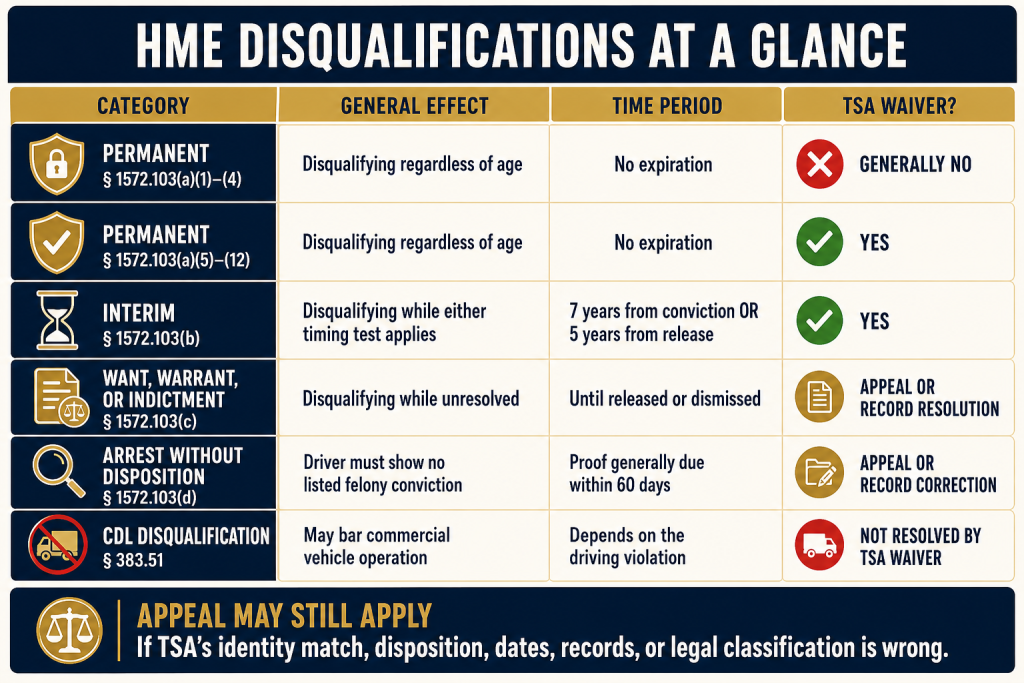
The Transportation Security Administration’s criminal-history regulation identifies particular felony offenses—not every felony—and divides them into permanent and interim disqualifying categories. Some offenses may be challenged through an appeal, some may qualify for a TSA waiver, and some interim offenses stop being disqualifying after the applicable conviction and incarceration periods expire.
The correct result depends on:
- The precise statute of conviction;
- Whether the final conviction was a felony;
- Whether the offense fits TSA’s federal category;
- The conviction date;
- The release-from-incarceration date;
- Whether a warrant or indictment remains active;
- Whether the offense is waivable;
- Whether TSA’s criminal-history information is accurate; and
- Whether a separate state or Federal Motor Carrier Safety Administration disqualification applies.
The federal criminal-offense list is found in 49 C.F.R. § 1572.103. The list is substantially the same for the Hazardous Materials Endorsement and Transportation Worker Identification Credential programs, but an HME case has an additional state-licensing layer.
TSA decides whether the driver passes the federal security threat assessment. The state licensing authority issues, renews, transfers, denies, or revokes the endorsement on the commercial driver’s license.
If TSA sends you an adverse threat-assessment letter, you generally must initiate an appeal within 60 days after receiving the Initial Determination of Threat Assessment.
National Security Law Firm represents commercial drivers nationwide in HME appeals and waivers. We have handled HME and TWIC matters since 2016 and have represented applicants in hundreds of TSA credential cases.
For qualifying initial-stage HME appeals or waivers, our flat legal fee is $2,495. We review TSA’s letter, obtain ordinary court records, analyze the alleged disqualification, prepare the legal submission, and manage the matter through the covered TSA stage.
Schedule a free consultation or call (202) 600-4996.
What Can Disqualify You From a Hazmat Endorsement?
A commercial driver may be denied an HME because of:
- A permanent disqualifying felony;
- An interim disqualifying felony within the applicable time period;
- A want, warrant, or indictment for a listed felony;
- An arrest record that does not report the final disposition;
- Immigration-status ineligibility;
- A mental-capacity determination;
- Terrorism-related or other security information;
- A separate CDL or commercial-driving disqualification;
- Failure to satisfy state testing, licensing, training, or application requirements; or
- Incomplete, inconsistent, or unverifiable application information.
These grounds do not all have the same remedy.
A factual or legal error may call for a TSA appeal. An accurately reported but waivable condition may call for a TSA waiver. A separate state or FMCSA disqualification may require relief outside the TSA process.
TSA and the State Have Different HME Responsibilities
A hazardous materials endorsement is placed on a state-issued commercial driver’s license, but TSA performs the required federal security threat assessment.
Under 49 C.F.R. § 1572.13:
- A state may not issue or renew an HME unless TSA sends the state a Determination of No Security Threat.
- TSA sends the final threat-assessment result to the licensing state.
- The state records the result and reports it through the Commercial Driver’s License Information System.
- The state must deny or revoke the HME if TSA sends a Final Determination of Threat Assessment.
- If TSA issues an Initial Determination and Immediate Revocation, the state must revoke the HME immediately.
A successful TSA appeal or waiver resolves the federal security threat assessment. It does not automatically:
- Reinstate an expired CDL;
- Satisfy the state knowledge test;
- Complete entry-level driver training;
- Pay state licensing fees;
- Cure a medical-certificate problem;
- Remove a separate CDL disqualification;
- Require an employer to hire the driver; or
- Resolve an unrelated FMCSA safety issue.
The driver must satisfy both the federal TSA requirement and the remaining state and federal commercial-driving requirements.
What Does TSA Mean by “Convicted”?
TSA applies the federal definition in 49 C.F.R. § 1570.3.
The definition generally includes:
- A guilty plea;
- A plea of nolo contendere; or
- A finding of guilt.
The definition excludes a finding of guilt that has subsequently been:
- Overturned on appeal;
- Pardoned; or
- Expunged within TSA’s federal definition.
A state’s terminology does not necessarily determine the federal result.
For example, a state proceeding called an “expungement,” “set-aside,” “dismissal,” or “deferred adjudication” may have different legal effects. TSA examines what happened to the plea, finding, judgment, criminal-history record, and remaining legal disabilities.
If your conviction was vacated, reversed, dismissed after a deferred disposition, pardoned, expunged, or sealed, the complete order and underlying records should be reviewed before deciding whether to appeal or request a waiver.
Permanent Hazmat Endorsement Disqualifying Offenses
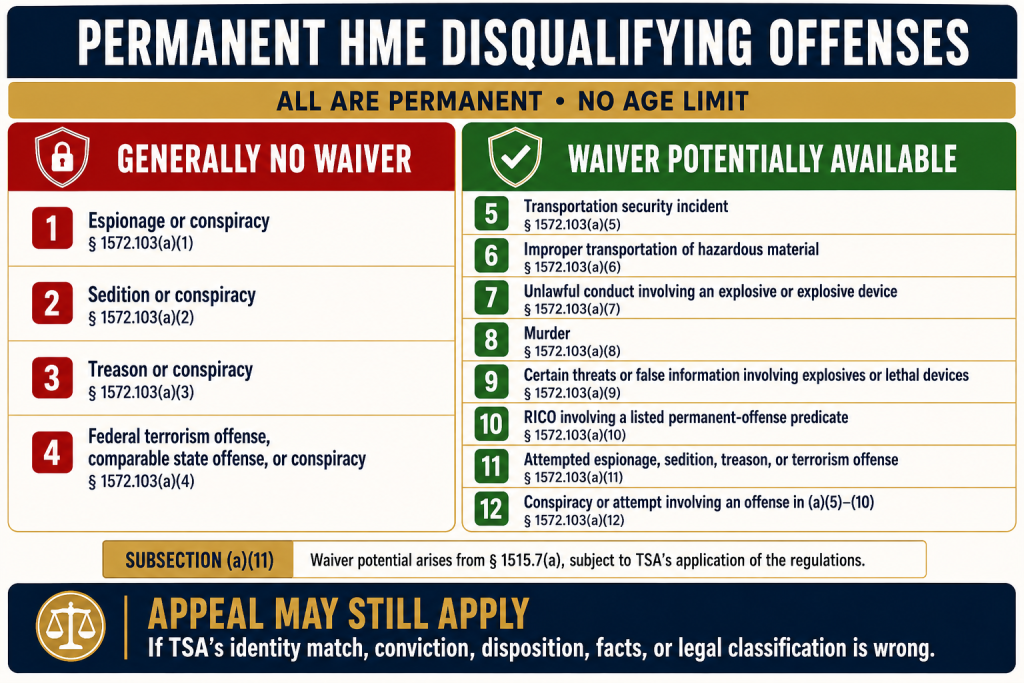
A driver has a permanent disqualifying offense if convicted—or found not guilty by reason of insanity—in a civilian or military jurisdiction of a felony listed in § 1572.103(a).
“Permanent” means the condition does not disappear merely because the conviction becomes old. It does not mean that every permanent offense is nonwaivable.
Which Permanent HME Offenses Cannot Be Waived?
TSA’s waiver regulation, 49 C.F.R. § 1515.7, covers permanent offenses listed in § 1572.103(a)(5) through (a)(12).
It does not include the completed offenses and conspiracies in § 1572.103(a)(1) through (a)(4):
- Espionage or conspiracy to commit espionage;
- Sedition or conspiracy to commit sedition;
- Treason or conspiracy to commit treason; and
- A federal crime of terrorism, comparable state offense, or conspiracy to commit that crime.
These conditions generally fall outside TSA’s criminal-offense waiver authority.
An appeal may still be appropriate if TSA’s identity match, record, disposition, or legal conclusion is wrong. An appeal disputes whether the disqualifying condition exists; it does not ask TSA to excuse an accurate condition.
Why Attempts and Conspiracies Require Careful Classification
The regulations create a technical distinction between certain attempts and conspiracies.
Completed espionage, sedition, treason, and terrorism offenses—and conspiracies to commit them—are placed in § 1572.103(a)(1) through (a)(4), outside the waiver regulation’s stated scope.
Attempts to commit those offenses are separately placed in § 1572.103(a)(11). Section 1515.7 expressly covers offenses under § 1572.103(a)(5) through (a)(12).
The text therefore places attempts under subsection (a)(11) within the waiver provision even though the corresponding completed offenses and conspiracies under subsections (a)(1) through (a)(4) are not.
This is a narrow regulatory distinction. A driver facing one of these determinations should not rely on a shortened TSA felony list or assume that “attempt” and “conspiracy” receive identical treatment.
What Is a Transportation Security Incident?
A crime involving a transportation security incident is permanently disqualifying but potentially waivable.
The regulation describes a transportation security incident as a security incident resulting in significant:
- Loss of life;
- Environmental damage;
- Transportation-system disruption; or
- Economic disruption in a particular area.
A work stoppage or other employee-related action resulting from an employer-employee dispute and unrelated to terrorism does not constitute “economic disruption” for this purpose.
The ordinary title of a conviction may not establish whether this category applies. TSA’s determination may require examination of the statute, charging language, plea, findings, and admitted or proven circumstances.
Is Improper Transportation of Hazardous Materials Permanently Disqualifying?
A felony conviction for improper transportation of hazardous material under 49 U.S.C. § 5124, or a comparable state law, is a permanent HME disqualifier.
This category is particularly important for commercial drivers because it may arise from conduct directly involving hazardous-material transportation.
However, not every hazardous-material citation, placarding violation, paperwork violation, or civil penalty is automatically a permanent disqualifying felony.
The analysis should determine:
- Whether there was a criminal conviction;
- Whether the conviction was a felony;
- The statute and subsection;
- Whether a state offense is actually comparable to § 5124;
- Whether the conviction involved knowing or willful conduct required by the statute; and
- Whether TSA accurately classified the case.
An administrative citation or civil enforcement action is not automatically equivalent to a felony conviction under this category.
Even when the conviction is accurately classified, § 1515.7 places § 1572.103(a)(6) within TSA’s waiver authority.
Are Explosives and Firearm Offenses Treated the Same?
No.
Permanent disqualifying offenses include broad categories of unlawful conduct involving an explosive or explosive device.
Firearm and other weapons offenses generally appear in the interim list.
A database entry using the phrase “weapon offense” does not establish whether TSA should classify the conviction as:
- A permanent explosives offense;
- An interim firearm or other weapons offense;
- A misdemeanor outside the listed-felony provisions; or
- A conviction that does not fit either category.
The item involved, statutory elements, charging instrument, judgment, and offense classification matter.
Interim Hazmat Endorsement Disqualifying Offenses
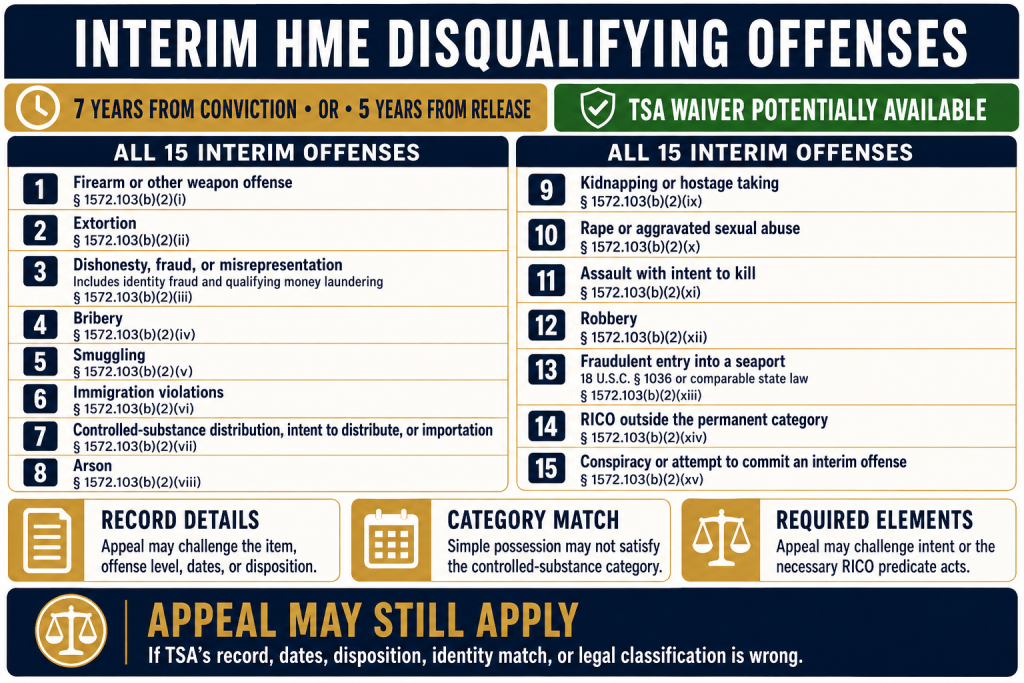
The interim categories apply only while one or both regulatory timing periods remain open.
Under § 1572.103(b), a listed interim felony is disqualifying if either:
- The driver was convicted or found not guilty by reason of insanity within seven years of the HME application; or
- The driver was incarcerated for that offense and released within five years of the application.
All interim offenses fall within TSA’s waiver authority.
How Do the Seven-Year and Five-Year HME Rules Work?
The timing rules are alternatives. A driver must be outside both periods before an interim conviction ceases to be disqualifying based on age.
The Seven-Year Conviction Period
TSA determines whether the conviction or finding of not guilty by reason of insanity occurred within seven years of the HME application date.
The relevant date is generally the conviction date—not:
- The arrest date;
- The offense date;
- The sentencing-completion date;
- The probation-completion date; or
- The date the conviction appeared in a background report.
The Five-Year Release Period
If the driver was incarcerated for the interim offense, TSA also examines whether the driver was released from incarceration within five years of the HME application.
The calculation may require records concerning:
- The original sentence;
- Resentencing;
- Concurrent or consecutive sentences;
- Parole revocation;
- Probation violations;
- Work release;
- Halfway-house placement;
- Treatment-facility placement; or
- Multiple periods of custody.
TSA’s definition of “incarceration” is broader than conventional full-time imprisonment and can include certain restrictions to a jail-type institution, halfway house, treatment facility, or another institution on a full- or part-time basis pursuant to a sentence.
Do not assume that the end of probation is the release-from-incarceration date. Obtain the official sentencing and corrections records.
Example: Old Conviction but Recent Release
Suppose a driver:
- Was convicted eight years before applying;
- Served a lengthy prison sentence; and
- Was released three years before applying.
The conviction is outside the seven-year period, but the release occurred within five years. The interim offense can therefore remain disqualifying.
Example: No Incarceration
Suppose a driver received probation and was never incarcerated for an interim felony. If the conviction occurred more than seven years before the application, the five-year release test may not independently create a disqualification.
The sentence and federal definition should still be reviewed because some residential or custodial conditions may qualify as incarceration.
Does a Misdemeanor Disqualify You From an HME?
TSA’s criminal-offense regulation identifies specified felonies.
A misdemeanor conviction ordinarily does not satisfy the criminal-conviction provisions in § 1572.103, even when the offense involved:
- Assault;
- A weapon;
- Fraud;
- A controlled substance;
- Theft; or
- Other serious-sounding conduct.
The offense name alone does not control. The driver should establish:
- The statute of conviction;
- The degree of the offense;
- The final judgment;
- Any amended charge;
- The jurisdiction’s classification; and
- The sentence imposed.
A felony arrest or original felony charge does not establish a felony conviction. If TSA relied on the charge instead of the misdemeanor disposition, the driver may have grounds for an appeal.
Does Simple Drug Possession Disqualify You From a Hazmat Endorsement?
Simple possession is not separately identified in TSA’s interim controlled-substance category.
Section 1572.103(b)(2)(vii) lists felony:
- Distribution;
- Possession with intent to distribute; and
- Importation of a controlled substance.
A criminal-history report may use a generic description such as “drug offense,” “controlled substance,” or “narcotics.” That label does not prove that the conviction involved distribution or intent to distribute.
A driver may have grounds to appeal if the official records establish only:
- Simple possession;
- A misdemeanor;
- A dismissed distribution count;
- An amended charge; or
- Another offense outside TSA’s identified category.
The appeal should include the judgment, charging instrument, statute, and any plea records necessary to establish the actual conviction.
A separate commercial-driving drug or alcohol disqualification may nevertheless exist under § 383.51. TSA’s criminal-offense analysis and the FMCSA safety rules are different systems.
Does a DUI Disqualify You From a Hazmat Endorsement?
A routine DUI or operating-under-the-influence conviction is not separately listed as a TSA criminal disqualifier in § 1572.103.
However, DUI-related conduct can create a separate CDL disqualification under 49 C.F.R. § 383.51.
For example, the FMCSA regulation imposes commercial-driving disqualification periods for certain alcohol and controlled-substance offenses. The period may be longer when the driver was operating a commercial motor vehicle transporting hazardous materials.
A driver can therefore pass TSA’s security threat assessment but remain unable to operate a commercial motor vehicle or use the endorsement because of a separate CDL disqualification.
Likewise, winning a TSA appeal or waiver does not erase a DUI suspension, return-to-duty requirement, or state licensing restriction.
Does a Felony Involving a Commercial Vehicle Create Two Problems?
Potentially.
A criminal conviction may trigger:
- A TSA security threat assessment disqualification under § 1572.103; and
- A separate commercial-driving disqualification under § 383.51.
For example, § 383.51 addresses:
- Using a vehicle to commit a felony;
- Using a vehicle in a felony involving manufacturing, distributing, or dispensing controlled substances;
- Operating under the influence of alcohol or controlled substances;
- Refusing required alcohol testing;
- Leaving an accident scene;
- Driving while commercially disqualified;
- Causing a fatality through negligent operation of a CMV; and
- Certain human-trafficking offenses involving a CMV.
The two systems can produce different results.
A drug-distribution conviction may be waivable by TSA, but using a vehicle in the commission of a controlled-substance felony may create a lifetime commercial-driving disqualification that is not cured by the TSA waiver.
The driver must identify every obstacle before deciding what relief will restore the ability to work.
How Does § 383.51 Affect TSA’s HME Decision?
Under 49 C.F.R. § 1572.5, TSA generally will not issue a Determination of No Security Threat for an HME applicant whom the state or FMCSA has determined is disqualified under § 383.51 until the applicable authority determines that the driver is no longer disqualified.
This means a driver may need to resolve:
- The TSA disqualification;
- The state CDL record;
- The FMCSA disqualification; or
- More than one of those issues.
An HME appeal lawyer should not promise that a TSA victory alone will restore the endorsement without reviewing the driver’s CDL status.
What If the Background Report Uses the Wrong Offense Label?
The label appearing on a background report does not necessarily establish that the conviction satisfies TSA’s category.
Common examples include:
- “Drug offense” when the conviction was simple possession;
- “Aggravated assault” when the statute did not require intent to kill;
- “Weapons offense” when the conviction was a misdemeanor;
- “Explosives” when the item was not an explosive device under the applicable provision;
- “Fraud” when the case involved welfare fraud or passing bad checks, which TSA expressly excludes from its interim fraud category;
- “Robbery” when the final conviction was theft;
- “Terroristic threats” under a state statute that may not be comparable to TSA’s terrorism category; or
- A felony arrest listed without the later dismissal or reduction.
The proper analysis may require comparison of:
- The statute in effect at the time of the offense;
- The statutory elements;
- The charging instrument;
- The plea or trial record;
- The final judgment;
- Any amended or reduced charge;
- TSA’s regulatory category; and
- Relevant federal authority concerning comparability.
A commercial background report is an investigative starting point. It is not necessarily proof of the final disposition.
How Does TSA Treat Warrants and Pending Indictments?
Under § 1572.103(c), an HME applicant who is wanted or under indictment in a civilian or military jurisdiction for a listed felony is disqualified until:
- The want or warrant is released; or
- The indictment is dismissed.
A conviction is not required for this provision.
An appeal may be appropriate if:
- The warrant belongs to someone else;
- The warrant was recalled or quashed;
- The underlying case was resolved;
- The indictment was dismissed;
- The pending offense is not a listed felony; or
- The criminal-history record was not updated.
TSA generally will need official documentation from the court, prosecutor, or law-enforcement agency. A personal explanation that the matter is “closed” may not be enough.
What If TSA Finds an Arrest Without a Disposition?
A fingerprint-based criminal-history record may identify an arrest without showing what ultimately happened.
The missing information may be that:
- The prosecutor declined the case;
- The charge was dismissed;
- The driver was acquitted;
- The felony was reduced to a misdemeanor;
- The driver completed a diversion program;
- The conviction was reversed;
- A corrected judgment was entered; or
- The arrest did not belong to the driver.
Under § 1572.103(d), TSA generally gives the applicant 60 days after service of its notification to provide written proof that the arrest did not result in a conviction for the disqualifying offense.
If TSA does not receive sufficient proof, it may determine that the applicant is disqualified and notify the licensing state.
Supporting documents may include:
- A certified judgment;
- A dismissal or nolle prosequi order;
- A judgment of acquittal;
- An amended charging instrument;
- A prosecutor’s certification;
- A court clerk’s certification;
- A corrected state record; or
- A corrected FBI Identity History Summary.
How Do Pardons, Expungements, and Vacated Convictions Affect HME Eligibility?
Post-conviction relief can affect TSA’s analysis, but the title of the state proceeding does not necessarily determine the federal result.
Pardons
TSA’s federal definition of “convicted” excludes a finding of guilt that has been pardoned. The driver should provide the official pardon and records establishing the conviction it covers.
Reversed Convictions
A conviction overturned on appeal generally provides a strong basis to challenge a determination relying on that conviction.
Submit the appellate mandate, opinion, corrected judgment, docket, or other official evidence showing the current disposition.
Expungements
TSA uses a specific federal definition of an expunged conviction. Not every state process called an expungement meets it.
The regulation examines whether:
- The conviction was removed from the criminal-history record; and
- Legal disabilities or restrictions remain, other than possible use for sentencing in a later case.
Vacated or Set-Aside Judgments
A vacatur requires individualized review. Relevant questions include:
- What judgment was vacated?
- Why did the court grant relief?
- Was the underlying conviction legally defective?
- Was relief granted only for rehabilitative or employment reasons?
- Was a new plea or judgment entered?
- What does the current criminal-history record show?
Submit the complete signed order and any accompanying records necessary to establish the present disposition.
When Is an HME Appeal Appropriate?
An appeal disputes TSA’s facts or legal conclusion.
An HME appeal may be appropriate when:
- The criminal record belongs to another person;
- TSA treated an arrest as a conviction;
- The charge was dismissed;
- The driver was acquitted;
- The final conviction was a misdemeanor;
- The felony charge was reduced or amended;
- TSA used the wrong conviction date;
- TSA used the wrong release-from-incarceration date;
- Both interim timing periods have expired;
- The offense does not match TSA’s category;
- Simple possession was characterized as distribution;
- A warrant was recalled;
- An indictment was dismissed;
- The conviction was reversed, pardoned, or qualifyingly expunged;
- TSA’s immigration information is inaccurate; or
- TSA relied on an incorrect mental-capacity determination.
Read our complete guide explaining how to appeal a denied hazmat endorsement.
When Is an HME Waiver Appropriate?
A waiver generally accepts that an accurately reported disqualifying condition exists but asks TSA to determine that the driver does not pose a security threat.
Under § 1515.7, TSA may waive:
- Permanent offenses listed in § 1572.103(a)(5) through (a)(12);
- Every interim offense listed in § 1572.103(b);
- Certain Temporary Protected Status immigration conditions; and
- Certain mental-capacity conditions.
TSA considers factors including:
- The circumstances of the offense;
- Restitution;
- Federal or state mitigation remedies;
- Court records;
- Sentence completion;
- Time since the offense;
- Employment history;
- Commercial-driving history;
- Safety record;
- Treatment;
- Rehabilitation;
- Training and education;
- Employer support;
- Community involvement; and
- Other evidence showing that the driver does not pose a security threat.
A waiver is not granted merely because the driver needs the endorsement for work. Employment consequences matter, but the submission must address TSA’s security standard.
Learn more about HME waiver eligibility, rehabilitation evidence, and TSA review.
Can a Driver Appeal and Request a Waiver at the Same Time?
Potentially.
A driver may dispute TSA’s legal classification while requesting a waiver in the alternative.
For example:
The driver argues that the state conviction was for simple possession and does not match TSA’s drug-distribution category. If TSA rejects that argument, the driver alternatively requests a waiver and submits evidence of rehabilitation, safe driving, stable employment, and present reliability.
Alternative arguments should be drafted carefully. A poorly constructed waiver request may appear to concede a factual or legal issue the driver intends to dispute.
What Evidence Supports an HME Waiver?
The strongest waiver record is individualized. It should address both the offense and the driver’s present reliability.
Potential evidence includes:
- The charging instrument and final judgment;
- Sentencing records;
- Proof of release from incarceration;
- Proof of completing probation or parole;
- Restitution and fine-payment records;
- Treatment-completion records;
- Substance-use evaluations, when relevant;
- Employment history;
- CDL and driving records;
- Safety awards;
- Training certificates;
- Employer recommendations;
- Dispatch or supervisor letters;
- Evidence of successful hazardous-material or safety work;
- Professional licenses;
- Volunteer and community-service records;
- Educational achievements;
- Character references; and
- A credible personal statement addressing the offense and rehabilitation.
A commercial driver’s safety history can help or hurt. A strong record of compliant driving, safe hazardous-material handling, stable employment, and responsible conduct may support the waiver. Recent crashes, drug or alcohol violations, false log entries, out-of-service violations, or unsafe driving may undermine it.
What Are the HME Appeal and Waiver Deadlines?
Under 49 C.F.R. § 1515.5, a driver generally must initiate an ordinary appeal within 60 days after receiving TSA’s Initial Determination of Threat Assessment.
An appeal may be initiated by:
- Submitting a written reply;
- Requesting TSA’s releasable materials; or
- Requesting an extension under the regulation.
A waiver may be requested during the application process, after pursuing some or all of the appeal procedure, or no later than 60 days after service of TSA’s Final Determination of Threat Assessment.
TSA may grant extensions for good cause, but a driver should not assume an extension will be approved. Follow the deadline and instructions in the actual notice.
What Happens to the Endorsement After TSA’s Decision?
The answer depends on the driver’s procedural posture.
New Application
The state cannot issue the HME unless it receives a Determination of No Security Threat from TSA.
Renewal
The state must notify an HME holder about the security threat assessment at least 60 days before expiration. The driver may initiate the assessment after receiving notice but should do so no later than 60 days before the endorsement expires.
If TSA has not issued a determination by the expiration date, the state may extend the endorsement for 90 days. Any additional extension requires TSA’s advance approval.
Final Adverse Determination
If TSA serves the state with a Final Determination of Threat Assessment, the state must deny or revoke the HME and update the driver’s permanent record and CDLIS.
Immediate Revocation
If TSA issues an Initial Determination and Immediate Revocation, the state must revoke the endorsement immediately. The driver may be unable to transport hazardous materials while the appeal remains pending.
Transfer to Another State
When a driver transfers an existing HME from one state to another, the second state generally does not require a new TSA assessment until the preceding state’s assessment-renewal period expires, not to exceed five years.
A transfer does not erase an adverse TSA determination or separate CDL disqualification.
What Happens If TSA Denies an HME Waiver?
A waiver denial may be reviewed by a TSA Administrative Law Judge under 49 C.F.R. § 1515.11.
The request generally must be filed within 30 calendar days after service of the waiver denial.
The ALJ ordinarily reviews the evidence previously submitted to TSA. This creates an important closed-record problem: a driver generally cannot save critical rehabilitation evidence for the ALJ stage.
If the driver wants TSA to consider new evidence, the regulations generally require a new waiver request, and the pending ALJ proceeding may be dismissed.
The initial waiver submission should therefore be treated as the foundation of any later review—not as a preliminary letter that can easily be supplemented after denial.
Does Winning a TSA Appeal Guarantee the State Will Issue the HME?
No.
A successful TSA appeal or waiver can result in a Determination of No Security Threat, but the driver must still satisfy:
- State CDL eligibility;
- The hazardous-material knowledge test;
- Entry-level driver-training requirements, when applicable;
- State application and fee requirements;
- Medical-certification requirements;
- Any waiting or reinstatement rules;
- FMCSA disqualification rules; and
- Other applicable licensing conditions.
TSA decides the federal security question. The state controls the endorsement on the CDL, subject to federal commercial-driving law.
Can You Handle an HME Appeal or Waiver Without a Lawyer?
Yes. Federal law does not require an attorney for an initial HME appeal or waiver.
A straightforward record error may sometimes be resolved by submitting a certified disposition. Representation may be more valuable when:
- The offense classification is disputed;
- The record is incomplete;
- The state and federal categories differ;
- Multiple cases are involved;
- The seven-year and five-year calculations are unclear;
- A waiver requires substantial rehabilitation evidence;
- An appeal and waiver may both be necessary;
- The endorsement was immediately revoked;
- TSA has already rejected a submission;
- The record must be prepared for possible ALJ review;
- A separate FMCSA disqualification may exist; or
- The driver’s livelihood depends on the result.
The value of counsel is not simply placing a lawyer’s name on a letter. It is determining which legal problem exists, obtaining the records, applying the correct standards, building the evidence, and avoiding omissions that may damage later review.
Why Choose National Security Law Firm for an HME Case?
National Security Law Firm has handled HME and TWIC matters since 2016 and has represented applicants in hundreds of TSA credential cases nationwide.
For qualifying accepted matters, we handle the process rather than merely providing a generic template.
Our work generally includes:
- Reviewing every page of TSA’s notice;
- Identifying the deadline and procedural stage;
- Determining whether the matter requires an appeal, waiver, or both;
- Requesting TSA’s releasable materials when appropriate;
- Obtaining ordinary court and disposition records;
- Reviewing criminal-history information;
- Confirming the offense classification;
- Calculating the seven-year and five-year periods;
- Comparing the conviction to TSA’s regulatory category;
- Identifying incomplete or inaccurate source records;
- Developing rehabilitation and mitigation evidence;
- Reviewing the commercial-driving context;
- Preparing the written legal submission;
- Organizing supporting exhibits;
- Submitting the matter to TSA; and
- Managing the case through the covered initial stage.
We regularly communicate with TSA while representing our clients. That experience does not give NSLF special influence over TSA or a state licensing authority. It helps us identify the records, legal issues, and procedural decisions that matter.
For individualized representation, visit our HME appeal and waiver lawyer page.
How Much Does an HME Appeal or Waiver Lawyer Cost?
National Security Law Firm charges a flat legal fee of $2,495 for qualifying initial-stage HME appeal or waiver representation.
The covered service generally includes the legal analysis, ordinary court-record procurement, evidence development, preparation, submission, and case management described in the signed engagement agreement.
Unless expressly included, the fee does not cover:
- Unusual third-party expenses;
- Extensive litigation to correct a source record;
- A separate expungement or post-conviction proceeding;
- A new waiver after completing an appeal;
- Administrative Law Judge review;
- An administrative hearing;
- TSA Final Decision Maker review;
- Federal-court litigation;
- State CDL litigation or an administrative hearing;
- A separate FMCSA matter;
- CDL testing or training;
- State licensing fees; or
- An employment dispute.
The exact scope is governed by the signed engagement agreement.
For more information about government, state, training, and legal costs, read our guide to hazmat endorsement costs, TSA fees, and appeal lawyer fees.
Financing and the Written Refund Guarantee
Eligible clients may use Pay Later by Affirm to divide the legal fee into monthly payments. Financing eligibility and terms are determined by the financing provider.
National Security Law Firm also offers a written refund guarantee in qualifying accepted HME matters.
The refund guarantee is not a promise that TSA will approve an appeal, grant a waiver, issue a Determination of No Security Threat, or cause a state to issue an endorsement. TSA and the state licensing authority control their respective decisions, and no attorney can ethically guarantee a particular government result.
When the refund guarantee applies, the signed engagement agreement identifies the covered result and the circumstances under which NSLF will refund the covered $2,495 legal fee if that result is not achieved.
The guarantee:
- Applies only when expressly included in the signed engagement agreement;
- Covers only the legal fee identified in that agreement;
- Is subject to the agreement’s terms, exclusions, and client responsibilities;
- Does not control or guarantee TSA’s decision;
- Does not guarantee state CDL or HME issuance;
- Does not resolve a separate FMCSA disqualification; and
- Does not necessarily cover third-party expenses or advanced proceedings.
We do not accept every matter for guaranteed representation. We first review TSA’s notice, the procedural stage, alleged disqualification, deadlines, driving record, available court records, and known facts.
Frequently Asked Questions About Hazmat Endorsement Disqualifications
Does every felony disqualify you from a hazmat endorsement?
No. TSA’s regulation identifies particular felony categories. A felony that does not fit one of those categories is not automatically disqualifying under § 1572.103.
Can a felon get a hazmat endorsement?
Often, yes. The result depends on the offense, dates, sentence, waiver eligibility, official records, and whether a separate CDL disqualification applies. Read our guide explaining when a person with a felony may qualify for a hazmat endorsement.
Are misdemeanors HME disqualifiers?
The criminal-offense provisions identify specified felonies. A genuine misdemeanor conviction ordinarily does not qualify, although TSA may need official records proving the disposition.
Are all permanent offenses nonwaivable?
No. Permanent offenses under § 1572.103(a)(5) through (a)(12) fall within TSA’s waiver regulation. The completed offenses and conspiracies under (a)(1) through (a)(4) generally do not.
Are all interim offenses waivable?
Yes. Section 1515.7 places all interim offenses listed in § 1572.103(b) within TSA’s waiver authority.
Must both the seven-year and five-year periods expire?
Yes. An interim offense remains disqualifying if either the conviction occurred within seven years of the application or the driver was released from incarceration for that offense within five years.
Does probation count as incarceration?
Probation is not automatically incarceration. However, TSA’s definition can include certain placements in halfway houses, treatment facilities, or similar institutions. Review the sentence and actual custodial conditions.
Does a DUI disqualify you from the TSA HME assessment?
A routine DUI is not separately listed in § 1572.103. It may nevertheless create a separate CDL disqualification under § 383.51, especially when the driver was operating a commercial vehicle or transporting hazardous materials.
Does simple drug possession disqualify you?
Simple possession is not separately listed in TSA’s interim drug category. That category identifies distribution, possession with intent to distribute, and importation. A separate CDL or state issue may still apply.
Can a dismissed felony charge disqualify you?
A dismissed charge is not a felony conviction. A currently pending indictment or active warrant for a listed felony can be disqualifying until resolved.
Can TSA rely on an arrest without a conviction?
TSA may require the driver to prove the final disposition when a fingerprint record reports an arrest without an outcome. The applicant generally receives 60 days after service of TSA’s notice to provide written proof.
Does expungement automatically eliminate the HME problem?
No. TSA applies a federal definition of “convicted” and qualifying expungement. State procedures vary, so the complete order and remaining legal effects must be reviewed.
Does a TSA waiver remove a lifetime CDL disqualification?
No. A TSA waiver addresses the federal security threat assessment. It does not automatically remove a separate lifetime or temporary commercial-driving disqualification under § 383.51.
Does a TWIC automatically qualify someone for an HME?
A valid comparable TSA security threat assessment may affect the HME process, but the driver must still comply with applicable state CDL, testing, training, and endorsement requirements. The specific enrollment and assessment history should be reviewed.
Can TSA notify the state about an adverse decision?
Yes. TSA provides the final HME threat-assessment determination to the state. The state records the result, updates CDLIS, and denies or revokes the endorsement when required.
Does NSLF guarantee that I will receive an HME?
No. NSLF cannot guarantee TSA’s or a state’s decision. Qualifying accepted cases may include a contractual refund guarantee under the precise terms of the signed engagement agreement.
Schedule a Free Consultation About an HME Disqualification
A hazardous materials endorsement can be essential to a commercial driver’s job, routes, earning potential, and future opportunities. But an adverse TSA letter does not always mean the driver is permanently barred.
The strongest response begins by determining:
- What TSA found;
- Whether the record is accurate;
- Whether the conviction fits a listed category;
- Whether the seven-year and five-year periods still apply;
- Whether an appeal, waiver, or both are appropriate; and
- Whether a separate state or FMCSA disqualification must also be addressed.
National Security Law Firm has handled HME and TWIC matters since 2016 and represents commercial drivers nationwide. For qualifying cases, we obtain the ordinary court records, perform the legal analysis, develop the evidence, prepare the submission, and manage the covered TSA proceeding.
Our flat legal fee for qualifying initial-stage representation is $2,495. Financing may be available, and qualifying accepted matters may include a written refund guarantee subject to the engagement agreement’s precise terms.
Schedule a free consultation or call (202) 600-4996.
Official HME Disqualification Resources
- TSA: Hazardous Materials Endorsement Threat Assessment Program
- TSA: Disqualifying Offenses and Factors
- 49 C.F.R. § 1570.3—TSA Definitions
- 49 C.F.R. § 1572.5—Security Threat Assessment Standards
- 49 C.F.R. § 1572.13—State HME Responsibilities
- 49 C.F.R. § 1572.103—Disqualifying Criminal Offenses
- 49 C.F.R. § 1515.5—Appeal of an Initial Determination
- 49 C.F.R. § 1515.7—TSA Waiver Procedures
- 49 C.F.R. § 1515.11—Administrative Law Judge and TSA Final Decision Maker Review
- 49 C.F.R. § 383.51—Commercial Driver Disqualifications
- 49 U.S.C. § 5103a—Limitation on Issuance of Hazmat Licenses
- 49 U.S.C. § 5124—Criminal Penalty for Hazardous-Materials Violations
Author: Katherine O’Brien, Esq., Founder, National Security Law Firm
Attorney Reviewed: August 26, 2026
This page provides general information and is not legal advice. Viewing this page or contacting the firm does not create an attorney-client relationship. Past results do not guarantee future outcomes. Any fee, scope of representation, financing arrangement, or refund guarantee is governed exclusively by a signed written engagement agreement.