
The SF-85, SF-85P and SF-86 are federal questionnaires used to begin different types of personnel-vetting investigations. They are not interchangeable, and completing one does not by itself grant a federal job, a Public Trust determination or a security clearance.
The shortest accurate explanation is:
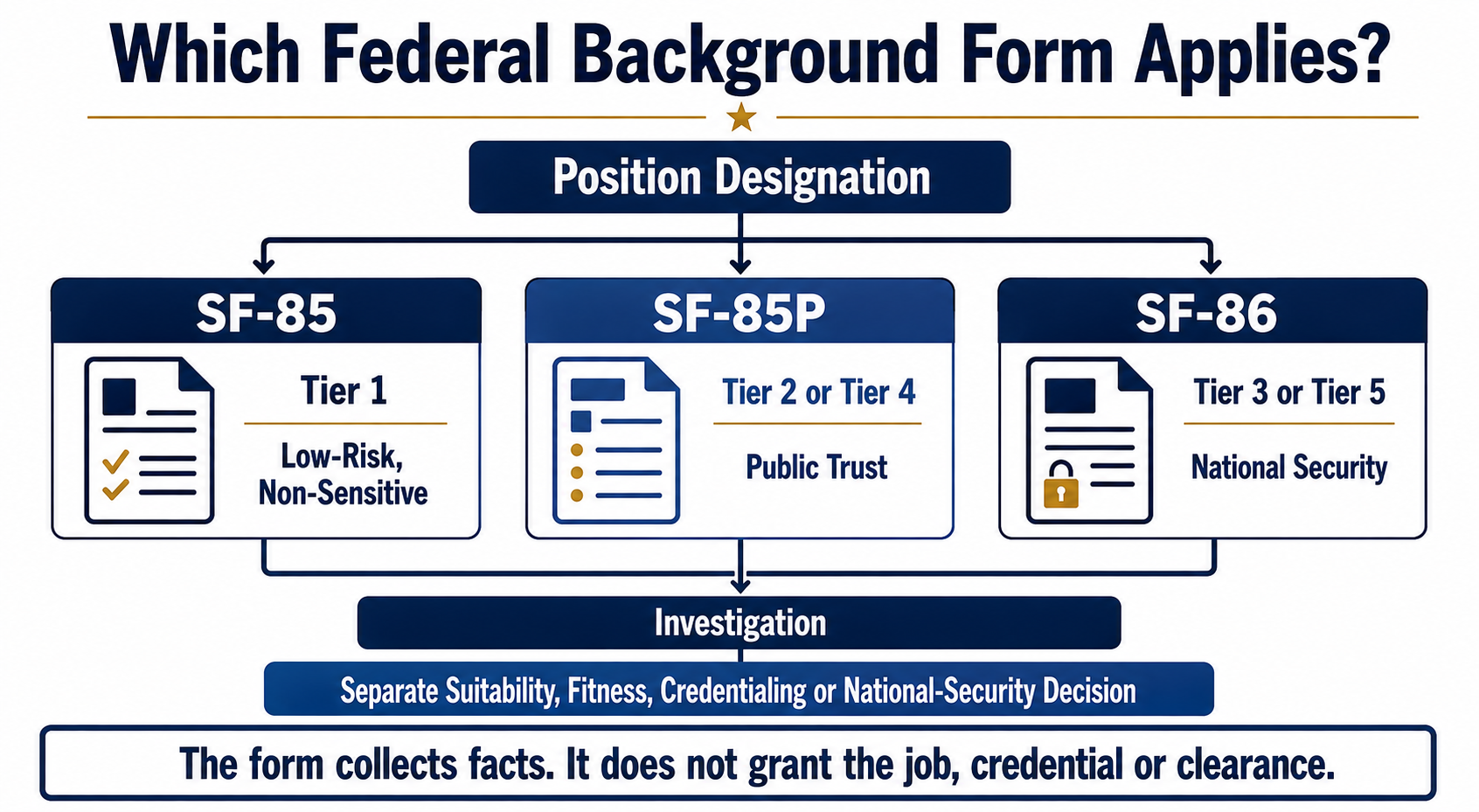
- The SF-85 is generally used for low-risk, non-sensitive positions.
- The SF-85P is generally used for moderate- or high-risk Public Trust positions that are not designated national-security sensitive.
- The SF-86 is used for national-security positions, including positions requiring eligibility for access to classified information and some sensitive positions that do not require classified access.
- The SF-85P-S is a supplement that an agency may require from selected SF-85P applicants. It is not a fourth stand-alone investigation form.
Your sponsoring agency—not the applicant—designates the position and initiates the appropriate investigation. The correct form depends on the position’s risk and sensitivity, the duties involved and the potential harm that misconduct or unauthorized access could cause.
Need help before you certify a federal background form? National Security Law Firm advises federal applicants, employees, military members and government contractors nationwide. We can review the form, identify issues that require explanation and help you build a complete, accurate record before submission.
★★★★★ 4.9 Stars From 300+ Google Reviews
Investigation · Personnel Security · Adjudication · DOHA · Hearings · Appeals
SF-85 vs. SF-85P vs. SF-86 at a Glance
| Form | Official name | Positions commonly associated with it | Common investigation tier | Decision it generally supports | Is it a security-clearance form? |
|---|---|---|---|---|---|
| SF-85 | Questionnaire for Non-Sensitive Positions | Low-risk, non-sensitive federal or federal-contractor positions | Tier 1 | Suitability, fitness or credentialing determination | No |
| SF-85P | Questionnaire for Public Trust Positions | Moderate- or high-risk Public Trust positions that are non-sensitive | Tier 2 or Tier 4 | Suitability, fitness or Public Trust determination | No |
| SF-85P-S | Supplemental Questionnaire for Selected Positions | Certain positions whose agencies require additional job-related information | Used with the SF-85P | Supplements the SF-85P on selected issues | No; it is a supplement |
| SF-86 | Questionnaire for National Security Positions | National-security sensitive positions and positions requiring classified access eligibility | Tier 3 or Tier 5 | National-security eligibility, sensitive-position eligibility and, when required, access eligibility | It can support a clearance determination, but the form itself is not a clearance |
This table provides the general framework. An agency’s position designation and investigation request control in an individual case.
Important: A Public Trust position is not the same as a security-cleared position. “Public Trust” describes the risk associated with certain non-sensitive duties. A security clearance concerns eligibility for access to classified information.
Who Decides Which Form You Complete?
The hiring or sponsoring agency determines which questionnaire and investigation apply. It does so by evaluating the position—not by asking the applicant to choose a form.
Federal position designation considers two related but distinct concepts:
- Risk concerns the potential harm that a person could cause through misconduct, poor performance or misuse of the position.
- Sensitivity concerns the potential impact on national security.
A position can carry substantial public-trust risk without requiring access to classified information. Conversely, a national-security position may require an SF-86 even when the employee does not expect to handle classified documents every day.
That is why statements such as “SF-85P means Secret clearance” or “SF-86 always means Top Secret” are incorrect. The form is one part of the personnel-vetting process; it does not tell the entire story about the job or the ultimate access decision.
What Is the SF-85?
The Standard Form 85, Questionnaire for Non-Sensitive Positions, is generally used for people being considered for low-risk federal employment or comparable low-risk work for the government.
The form may support:
- A suitability determination for competitive-service employment;
- A fitness determination for excepted-service employment or contract work;
- A determination concerning eligibility for a federal credential; or
- A reinvestigation or later personnel-vetting decision.
The SF-85 collects identifying and background information such as residences, education, employment, military history, police record and certain illegal drug activity. Its scope is narrower than the SF-85P and SF-86 because it is designed for non-sensitive, low-risk positions.
Does the SF-85 provide a security clearance?
No. The SF-85 is not used to grant eligibility for access to classified information. A person who favorably completes an SF-85 investigation may be approved for the position or credential at issue, but that approval is not a Confidential, Secret or Top Secret clearance.
Is an SF-85 investigation “just a basic background check”?
It is the least intensive of the three principal questionnaire tracks, but it should still be taken seriously. The completed form becomes part of a federal record. Information may be verified, compared with government databases and considered in later investigations. An inaccurate answer on an SF-85 can create a problem even if the underlying event would not have prevented employment.
What Is the SF-85P?
The Standard Form 85P, Questionnaire for Public Trust Positions, is generally used for non-sensitive positions designated as moderate or high risk. These positions may involve substantial responsibility, access to sensitive systems or information, fiduciary duties, law-enforcement responsibilities, public safety or opportunities to affect government operations.
Depending on the position designation, an SF-85P commonly supports a Tier 2 or Tier 4 investigation.
The SF-85P requests more extensive information than the SF-85. It may inquire about matters including residences, education, employment, people who know the applicant, police record, illegal drug activity, alcohol-related issues, financial history and prior federal investigations.
Is Public Trust a security clearance?
No. This is one of the most common sources of confusion in federal hiring.
A Public Trust determination concerns whether a person is suitable or fit to perform duties in a moderate- or high-risk non-sensitive position. A security-clearance determination concerns eligibility for access to classified national-security information. Both may involve substantial investigations, but they serve different legal and operational purposes.
People sometimes describe a Public Trust approval as a “Public Trust clearance.” That phrase is common in conversation and job postings, but it is not technically accurate.
Can a Public Trust denial affect future federal work?
Yes. The precise effect depends on the authority used, the agency’s decision, the position and any appeal rights stated in the notice. The completed SF-85P is also a permanent federal record and may be reviewed in later personnel-vetting matters.
If you have received a proposed or final unfavorable decision, do not assume that the procedures are identical to a security-clearance case. Start with the notice, identify the deciding authority and determine the applicable response or appeal process.
Learn more: Public Trust Background Investigations and Denials
What Is the SF-85P-S?
The SF-85P-S, Supplemental Questionnaire for Selected Positions, may be used with the SF-85P when an agency determines that additional information is relevant to the duties of a particular position.
The supplement contains selected questions involving illegal drug use, alcohol use and specified psychological or emotional-health circumstances. An agency should tell the applicant which questions must be answered. The supplement is not automatically required for every person who completes an SF-85P.
The SF-85P-S does not replace the SF-85P and does not independently create a security-clearance investigation.
What Is the SF-86?
The Standard Form 86, Questionnaire for National Security Positions, is used for investigations involving national-security sensitive positions. It is the form most commonly associated with Confidential, Secret, Top Secret and Sensitive Compartmented Information eligibility, but its use is broader than classified access alone.
An agency may require the SF-86 for:
- A position requiring eligibility for access to classified information;
- A national-security sensitive position that does not require routine classified access;
- Continued eligibility, reinvestigation or vetting associated with a national-security position;
- Certain federal appointments or assignments requiring a national-security determination; or
- Related credentialing, suitability or fitness determinations when the investigation also serves those purposes.
The SF-86 generally supports a Tier 3 or Tier 5 investigation. Tier 3 is commonly associated with noncritical-sensitive positions and Secret or Confidential access eligibility. Tier 5 is commonly associated with critical-sensitive or special-sensitive positions and Top Secret or Sensitive Compartmented Information eligibility. The position and access requirements—not the applicant’s preference—determine the investigation.
Does completing an SF-86 mean you have a security clearance?
No. Completing the SF-86 begins or supports the investigation. It does not mean that the applicant has been found eligible, that access has been granted or that the person currently holds a clearance.
A security-clearance process can involve several distinct stages:
- The organization sponsors the individual and initiates the investigation.
- The individual completes and certifies the SF-86 and required releases.
- The questionnaire is reviewed for completeness and released for investigation.
- Investigators collect and verify relevant information.
- An authorized adjudicative authority determines eligibility under the applicable standards.
- The employing organization separately determines whether and when access is needed and grants access.
Eligibility and access are related but different. A person may have favorable eligibility without currently occupying a position that requires access.
For detailed pre-submission guidance, visit our SF-86 Security Clearance Lawyer page.
How Do the Federal Investigation Tiers Relate to the Forms?
Federal personnel vetting uses investigation tiers that generally correspond to the position’s risk and sensitivity.
| Investigation tier | Questionnaire commonly used | General position category |
|---|---|---|
| Tier 1 | SF-85 | Low-risk, non-sensitive |
| Tier 2 | SF-85P | Moderate-risk Public Trust, non-sensitive |
| Tier 3 | SF-86 | Noncritical-sensitive or equivalent national-security position |
| Tier 4 | SF-85P | High-risk Public Trust, non-sensitive |
| Tier 5 | SF-86 | Critical-sensitive or special-sensitive national-security position |
This framework is useful, but it should not be treated as a substitute for the agency’s position designation or investigation request. Federal personnel-vetting policy continues to evolve, and terminology used by employers or applicants may not match the formal designation.
Learn more: Tiered Background Investigations: What Tiers 1–5 Signal
Which Form Is the Most Detailed?
The SF-86 is generally the most extensive because it supports national-security determinations. It covers subjects that may not appear on the SF-85 or may be addressed less extensively on the SF-85P, including foreign contacts and activities, foreign travel, foreign financial interests, use of information technology systems and matters bearing on allegiance, influence, preference, judgment or reliability.
But “more detailed” does not mean that accuracy matters less on the shorter forms. Every form is signed and certified as true, complete and correct to the best of the applicant’s knowledge and belief. A false statement, concealment or material omission can create an independent issue.
Do all questions use the same reporting period?
No. Never use one assumed lookback period for the entire form.
Different sections may ask for different periods—such as five, seven or ten years—and some questions ask whether an event has ever occurred. Some instructions also contain exceptions, special rules or requests for information extending beyond the apparent time period.
Read the exact wording of each question, its definitions and its instructions. Do not rely solely on what a coworker, recruiter or online discussion says must be reported.
What the SF-85, SF-85P and SF-86 Have in Common
Although the forms serve different positions, several principles apply to all three.
1. The form becomes part of a federal record
The questionnaire is not a disposable application. It may be retained, reviewed in later investigations and compared with prior submissions. A later inconsistency can raise questions about accuracy, judgment or candor even when the original event is old.
2. The government may verify the answers
Investigators may use records, databases, interviews and other lawful sources to assess the information provided. The precise investigation depends on the tier and the case.
3. The applicant must answer the question actually asked
Applicants often get into trouble by answering a different question: what they believe is fair, what they think the government can find or what someone informally told them to disclose. The safer approach is to parse the question, identify the applicable dates and definitions, and answer accurately.
4. The underlying conduct and the disclosure are separate issues
An applicant may be able to explain and mitigate an old debt, drug involvement, arrest, employment problem or foreign connection. A deliberate omission can create an additional concern about honesty and reliability.
5. An explanation can matter as much as a checked box
A bare “yes” may identify an issue without giving the reviewer the context needed to evaluate it. When the form permits additional comments, a focused explanation may clarify dates, circumstances, resolution, recurrence risk and supporting records. More words are not always better; the explanation should be accurate, relevant and consistent with the evidence.
Common Mistakes on Federal Background-Investigation Forms
Guessing instead of researching
Applicants frequently estimate residence dates, employment periods, supervisor information, court dispositions or travel dates without first checking available records. Minor date differences are not necessarily disqualifying, but repeated inaccuracies can make the investigation harder and undermine confidence in the overall submission.
Assuming sealed, dismissed or expunged matters never count
Federal forms contain their own definitions and reporting instructions. A state-law label does not automatically determine the federal answer. Some questions expressly require disclosure of matters even if a record was sealed, expunged, dismissed or otherwise altered, while other questions contain exclusions.
The correct answer depends on the exact question and the facts. Do not answer from memory about what “expunged” generally means.
Copying an old form without rechecking it
Prior submissions can help reconstruct dates and history, but they may contain mistakes or no longer reflect current facts. Copying an earlier answer can repeat an error. Changing an earlier answer without explaining the reason can create a new inconsistency.
Treating marijuana as automatically irrelevant
Changes in state law do not eliminate federal reporting requirements. Answer the question based on its wording and the relevant federal standard, including dates, frequency, circumstances and any continuing involvement.
Confusing foreign travel with foreign contacts or foreign interests
On the SF-86, these subjects appear in different sections and use different definitions. Reporting a trip does not necessarily satisfy a separate duty to report a continuing foreign contact, foreign benefit, foreign property or foreign financial interest.
Providing a conclusion instead of facts
Statements such as “the debt was not my fault,” “the arrest was dismissed” or “the contact is not close” may leave the reviewer without the facts needed to evaluate the issue. A useful explanation identifies what occurred, when it occurred, what the applicant did and what the current circumstances are.
Overdisclosing without a plan
Complete disclosure is essential, but dumping unrelated facts, speculation or privileged detail into an answer can create confusion. The goal is not to minimize or exaggerate. It is to answer the question fully, accurately and in a form that can be understood and verified.
Failing to save a copy
Applicants should preserve the completed questionnaire, certification pages, releases and any supplemental explanation they are permitted to retain. Access to the electronic system may end after submission, and the form may matter in a later interview, reinvestigation or adjudication.
Can Prior Forms Be Compared With a New SF-85, SF-85P or SF-86?
Yes. The federal forms advise applicants that the information may be used in future investigations and that current answers may be compared with prior questionnaires.
That comparison can reveal:
- An event disclosed now but omitted earlier;
- Conflicting dates, frequency or descriptions;
- A changed explanation for the same conduct;
- A foreign contact, debt, job or residence that disappeared from the history; or
- A correction that is accurate but unexplained.
Not every difference is evidence of dishonesty. Memories improve, records become available, questions change and applicants sometimes discover innocent mistakes. But an unexplained inconsistency gives the government room to infer what happened.
Before submitting a new form, compare it with every prior federal questionnaire you can obtain. If a material answer changed, determine whether the current form provides an appropriate place to explain why.
Read more: The Record Controls the Case: How Your File Gets Reused
How Can You Get a Copy of a Prior Form?
If you previously completed an SF-85, SF-85P or SF-86 in e-QIP or the National Background Investigation Services electronic application system, first contact the human-resources or security office that sponsored the investigation. That office may be able to provide the archived questionnaire.
If the sponsoring office cannot retrieve it, the Defense Counterintelligence and Security Agency (DCSA) provides a process for requesting background-investigation records. Processing can take time, so do not wait until a submission deadline is near.
Do Applicants Still Use e-QIP?
Generally, no. DCSA replaced the Electronic Questionnaires for Investigations Processing system, commonly called e-QIP, with the National Background Investigation Services electronic application, commonly called NBIS eApp.
Many older agency webpages, instructions and online articles still use “e-QIP” as a generic term. In a current case, follow the link and instructions supplied by the sponsoring agency. Applicants cannot normally initiate their own investigation or select a form without sponsorship.
DCSA made the February 2024 editions of the SF-85, SF-85P, SF-85P-S and SF-86 available in eApp in May 2025 and stopped accepting earlier editions for new submissions on August 1, 2025. Applicants ordinarily complete the questionnaire electronically; the static government PDFs are best treated as references unless the sponsoring agency instructs otherwise.
What Happens After You Submit the Form?
The sequence varies, but the process commonly includes:
- Agency review. The sponsoring office checks the questionnaire for completeness and may return it for correction.
- Investigation. The authorized investigative service collects information appropriate to the requested tier.
- Applicant interview or follow-up. Some investigations and issues require an interview, records or additional explanation.
- Adjudication. The authorized agency evaluates the developed record under the standards applicable to the position and determination.
- Employment, credential or access action. The organization makes the operational decision within its authority.
- Continuous vetting or later review. Favorable eligibility is not a permanent exemption from reporting and review obligations.
The terminology matters. “Form submitted,” “investigation open,” “investigation closed,” “eligibility favorable” and “access granted” describe different events.
If you are trying to determine where your case stands, see How to Check Your Security Clearance Status.
What Should You Do If You Discover an Error After Submission?
Do not assume that an error cannot be corrected, and do not wait for an investigator to find it if the information is material.
Contact the sponsoring human-resources, personnel-security or facility-security office promptly. Identify the exact question, state the accurate information and explain how the error occurred. Keep a copy of the correction and the communication transmitting it.
The method for correcting a form depends on where the submission is in the process. The agency may return the electronic questionnaire, direct the applicant to provide written supplemental information or instruct the applicant to discuss the correction during an interview.
A prompt, documented correction is usually easier to explain than an inconsistency discovered later. However, the content and timing of a correction can have legal consequences. If the error concerns a significant omission, a prior false statement, criminal exposure or an issue likely to affect employment or clearance eligibility, consider obtaining legal advice before submitting an improvised explanation.
When Does a Background Form Become a Legal Problem?
Many applicants can complete these forms without an attorney. Legal review becomes more valuable when the facts, the disclosure duty or the consequences are not straightforward.
Consider seeking advice when:
- You are unsure whether a prior event falls within a question;
- A prior SF-85, SF-85P, SF-86 or other government form contains a conflicting answer;
- You omitted or misstated material information on an earlier submission;
- The case involves criminal conduct, drug involvement, tax problems, significant debt, foreign influence, foreign preference, misuse of information systems or employment misconduct;
- You have been asked to provide a written explanation or participate in an interview;
- You believe a supervisor or security representative is directing you to answer inaccurately;
- You received an unfavorable suitability, fitness, Public Trust or national-security notice;
- The form issue could affect a professional license, military status or criminal investigation; or
- You want a privileged legal review before certifying the questionnaire.
If the government has already issued a Statement of Reasons, Letter of Intent, proposed action or denial notice, the matter has moved beyond ordinary form preparation. The notice and deadline should be reviewed immediately.
Related resources:
- Security Clearance Statement of Reasons Lawyer
- Security Clearance Appeals Lawyers
- DOHA Security Clearance Lawyer
The Form Is Only the First Version of the Government’s Record
The most important work is often not deciding whether to check “yes.” It is making sure the answer will remain accurate when it is compared with records, tested in an interview and read later by an adjudicator.
National Security Law Firm approaches pre-submission review as record development:
We define the disclosure question
We examine the form’s time period, definitions, exceptions and instructions before evaluating the facts. That prevents an applicant from importing assumptions from state law, workplace jargon or an older edition of the form.
We build a disclosure map
We compare the proposed answer with prior questionnaires, court records, tax documents, employment history, travel, financial information and other materials likely to become part of the investigation. The goal is to find inconsistencies before the government does.
We make the explanation interview-ready
An explanation should not collapse when an investigator asks the next question. We help organize the chronology, supporting evidence, corrective action and current circumstances so the written answer and later testimony tell the same truthful story.
We protect the next decision, not only this submission
The form may be reused in a later investigation, adjudication, appeal or continuous-vetting review. We consider how the present language will read in that future record.
This work draws on the perspectives of attorneys who have operated at different points in the federal decision process: a former federal Administrative Judge and Acting Chief Judge, former government adjudicators, former intelligence counsel, an attorney with direct DOHA experience and experienced hearing counsel. When appropriate, complex matters can be reviewed through NSLF’s Attorney Review Board.
★★★★★
“I Retained National Security Law Firm for My Pre-Clearance Process and It Was Absolutely Worth It.”
“They did a thorough review, provided clear and compliant feedback, and then reviewed everything again after I made the updates. Even after submission, they remained available and responsive throughout the pre-investigation, investigation, and post-investigation phases… I ultimately had favorable results.”
— C.F., Pre-Clearance Client
Google Review
This review describes one client’s experience. Past results do not guarantee a similar outcome.
Frequently Asked Questions
What is the main difference between the SF-85, SF-85P and SF-86?
The SF-85 is generally for low-risk non-sensitive positions, the SF-85P for moderate- or high-risk Public Trust positions, and the SF-86 for national-security positions. The sponsoring agency determines the correct form based on the position designation.
Is the SF-85 a security-clearance form?
No. The SF-85 supports investigations for low-risk, non-sensitive positions and certain credentialing, suitability or fitness decisions.
Is the SF-85P a security clearance?
No. The SF-85P supports a Public Trust, suitability or fitness investigation. Public Trust is not a level of security clearance.
Is an SF-86 only for a Top Secret clearance?
No. The SF-86 is used for national-security positions at different sensitivity and access levels. It commonly supports Tier 3 and Tier 5 investigations, including matters associated with Secret, Top Secret and other national-security eligibility determinations.
Does completing the SF-86 mean I have a clearance?
No. Completing the questionnaire is part of the investigation process. An authorized adjudicative authority must make an eligibility determination, and the employing organization must separately grant access when needed.
What is the SF-85P-S?
It is a supplement used with the SF-85P for selected positions when the agency requires additional job-related information. It is not a stand-alone form and is not required in every Public Trust case.
Which form is used for Tier 1?
Tier 1 generally uses the SF-85 and applies to low-risk, non-sensitive positions.
Which form is used for Tier 2 or Tier 4?
Tier 2 and Tier 4 investigations generally use the SF-85P for moderate- and high-risk Public Trust positions.
Which form is used for Tier 3 or Tier 5?
Tier 3 and Tier 5 investigations generally use the SF-86 for national-security positions.
Can I choose to complete a different form?
No. The sponsoring agency designates the position and initiates the appropriate investigation. If you believe the wrong form was assigned, raise the issue with the sponsoring personnel-security or human-resources office.
How far back do the forms ask?
There is no single reporting period for an entire form. The period varies by section, and some questions ask whether conduct has ever occurred. Follow the exact wording and instructions for each question.
Do I have to list an expunged or sealed record?
Possibly. The answer depends on the specific federal question, its instructions and the facts. Some federal questions require information despite a sealed, expunged or dismissed record; others contain exclusions. Do not assume state-law terminology resolves the federal disclosure requirement.
Can the government compare my new form with an old one?
Yes. The forms are permanent records and may be used in future investigations. Current answers can be compared with earlier questionnaires and other government records.
What if an answer on my prior form was wrong?
Do not simply repeat the error, but do not silently change a material fact without considering whether an explanation is needed. Determine the accurate answer, document the supporting facts and consider legal advice if the prior error was significant.
Can I correct a form after submitting it?
Often, yes, but the method depends on the stage of the case. Contact the sponsoring security, human-resources or facility-security office promptly and preserve written proof of the correction.
Should I disclose more than the form asks?
You should provide a complete and accurate answer to the question asked. Unfocused overdisclosure can create confusion, while omission can create an independent candor problem. When an issue is complicated, a focused supplemental explanation may be appropriate.
Will bankruptcy automatically disqualify me?
No. Bankruptcy by itself does not automatically determine suitability, fitness or security eligibility. The government may examine the causes, surrounding conduct, legal compliance, resolution and current financial circumstances under the standards applicable to the position.
Does seeking mental-health treatment disqualify me?
No. Seeking treatment is not, by itself, disqualifying. Answer the current form’s narrowly worded questions accurately. The government’s concern is generally whether a condition or conduct may affect judgment, reliability, trustworthiness or the ability to safeguard protected information—not the responsible act of obtaining help.
Can my security officer tell me how to answer?
The security office can explain process and return incomplete submissions, but the applicant is responsible for certifying the answers. If anyone directs you to omit responsive information or provide an inaccurate answer, obtain independent advice.
Do I need a lawyer to complete an SF-85, SF-85P or SF-86?
Most applicants do not. Legal review is most useful when the disclosure requirement is uncertain, prior answers conflict, the issue could cause a denial or the response may create employment, military or criminal consequences.
Official Federal Resources
- OPM Federal Investigation Forms
- Official SF-85: Questionnaire for Non-Sensitive Positions
- Official SF-85P: Questionnaire for Public Trust Positions
- Official SF-85P-S: Supplemental Questionnaire for Selected Positions
- Official SF-86: Questionnaire for National Security Positions
- DCSA Case Types and Forms
- DCSA Help Filling Out Forms
- DCSA Investigations and Clearance Process
- DCSA Requesting Background-Investigation Records
Federal forms, systems and personnel-vetting procedures can change. Use the version and instructions provided by your sponsoring agency and verify current requirements before submission.
Get the Record Right Before You Certify It
The best time to resolve a disclosure question is before an incomplete or inconsistent answer enters the federal record. NSLF can review your assigned form, prior submissions and supporting documents; identify issues that require explanation; and help you prepare a response that remains accurate through investigation and adjudication.
Nationwide representation. Confidential consultations available.