
Removal vs. Suppression: Which Strategy Should You Choose?
If you’ve found damaging online content about yourself—a news article, mugshot, arrest report, blog post, or other search result—you’ve probably come across two very different recommendations. Some companies recommend content removal. Others recommend suppression (sometimes called online reputation management). Many people assume those are simply two different ways of describing the same service. They’re not. They solve two very different problems. Understanding the difference may be one of the most important decisions you make before spending money on either approach.
In this guide, we’ll explain the difference between removal, deindexing, and suppression; the advantages and limitations of each; why we believe clients should generally pursue removal first whenever there’s a legitimate opportunity; when suppression still makes sense; and how National Security Law Firm’s business model allows clients to pursue the strongest possible outcome first.
Understanding the Difference
Content Removal
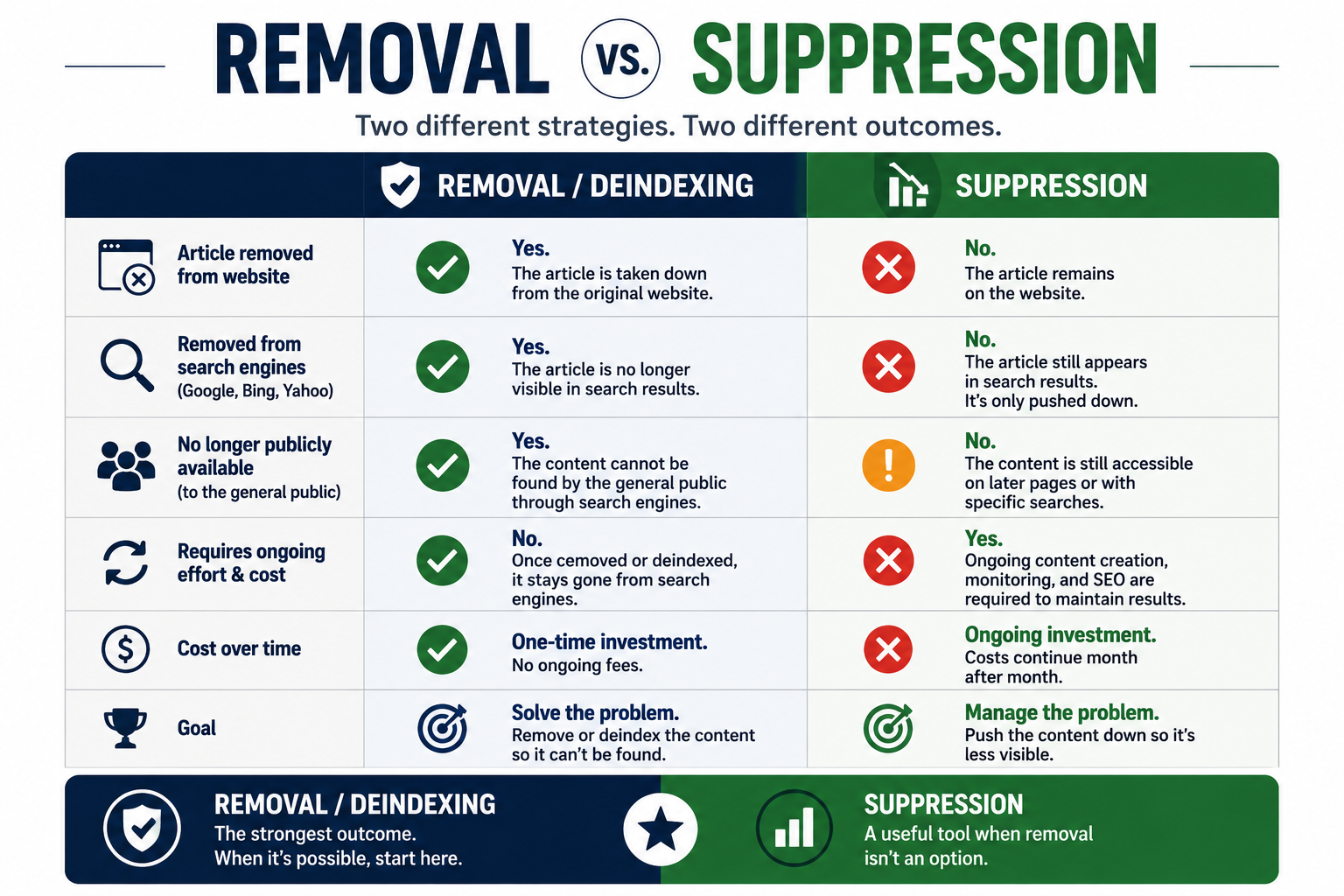
Content removal focuses on permanently eliminating the problem whenever there’s a legitimate opportunity. Depending on the circumstances, that may involve complete removal of the article, removal of your name (anonymization), or deindexing so the article no longer appears in Google search results. The goal is simple: prevent people from finding the content in the first place.
Content Suppression
Suppression takes a different approach. Instead of attempting to remove the content, suppression attempts to make it less visible. Reputation management companies generally accomplish this by creating or promoting positive online content designed to push negative articles farther down in Google search results. The article remains online. It simply becomes harder to find. For some clients, suppression can be an effective strategy. The important thing is understanding exactly what you’re buying. You’re not purchasing removal. You’re purchasing ongoing reputation management.
Why We Believe Removal Should Usually Come First
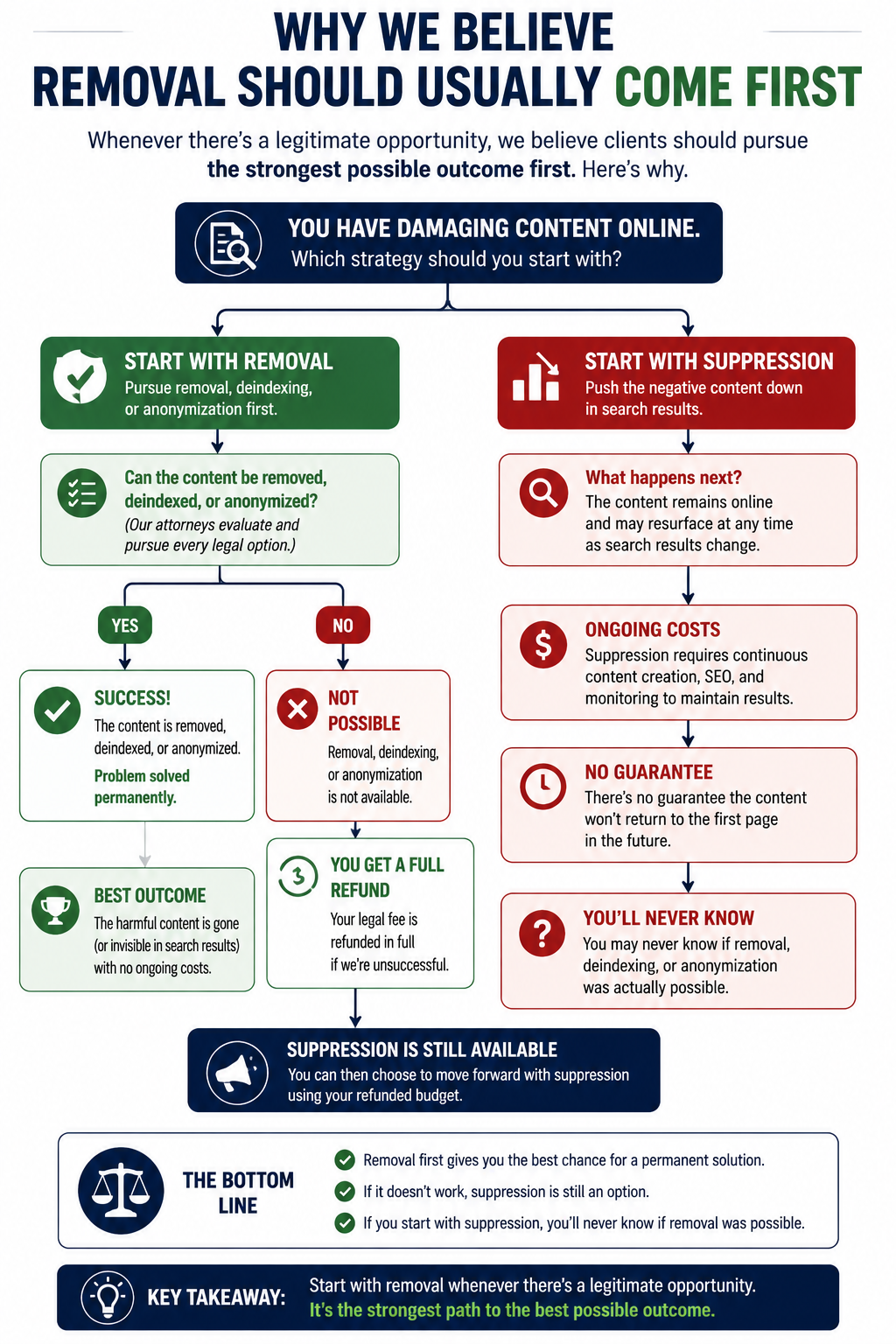
People often ask us: “If suppression works, why wouldn’t I just start there?” It’s a fair question. Whenever there’s a legitimate opportunity, we believe clients should pursue the strongest possible outcome first. Here’s why.
If you’re successful, you’ve permanently solved the problem. If you’re unsuccessful, suppression is still available. The reverse isn’t true. If you begin with suppression, you’ll never know whether permanent removal was possible. That’s one of the biggest reasons we’ve structured our practice the way we have.
Why Our Business Model Makes That Decision Easier
One of the biggest reasons people hesitate before pursuing removal is cost. They don’t want to spend thousands of dollars trying to remove something only to wonder later whether it was worth the risk. We understand that. That’s why we built our practice differently. If we’re unsuccessful under the terms of our representation agreement, we refund our legal fee in full. That allows our clients to pursue what we believe is the strongest possible outcome without permanently risking the money they invested in trying.
If we’re successful—fantastic. You’ve permanently solved the problem. If we’re not—your legal fee is refunded, and every other option—including suppression—remains available. We believe that’s the smartest way to approach these cases.
Is Suppression Ever the Right Choice?
Absolutely.
Although National Security Law Firm does not provide suppression services, we believe suppression has an important place in online reputation management.
It’s just important to understand what suppression actually does.
Suppression doesn’t remove an article.
It doesn’t remove your name.
It doesn’t deindex the content from search engines.
Instead, suppression attempts to make the content less visible by creating or promoting other online content that pushes the negative article farther down in search results.
The goal isn’t to eliminate the problem.
The goal is to make it less likely that someone will find it.
That’s an important distinction.
As attorneys, our practice focuses on removal, deindexing, and anonymization.
Suppression is generally performed by SEO and online reputation management companies—not law firms.
Whenever there’s a legitimate opportunity, we believe clients should first pursue the strongest opportunity for a permanent solution.
If removal or deindexing ultimately isn’t possible, suppression often becomes an excellent next step.
In many situations, it’s far better than doing nothing.
Can You Pursue Removal and Suppression at the Same Time?
Sometimes.
Certain clients choose to hire National Security Law Firm to pursue removal, deindexing, or anonymization while separately retaining an SEO or reputation management company to begin suppression efforts.
This dual-strategy approach may make sense when:
- A significant job opportunity is approaching.
- A professional license or security clearance decision is imminent.
- A business launch or public announcement is planned.
- Immediate reputation management is critical.
Every situation is different.
If we believe a dual strategy may benefit your particular circumstances, we’ll discuss that during your consultation.
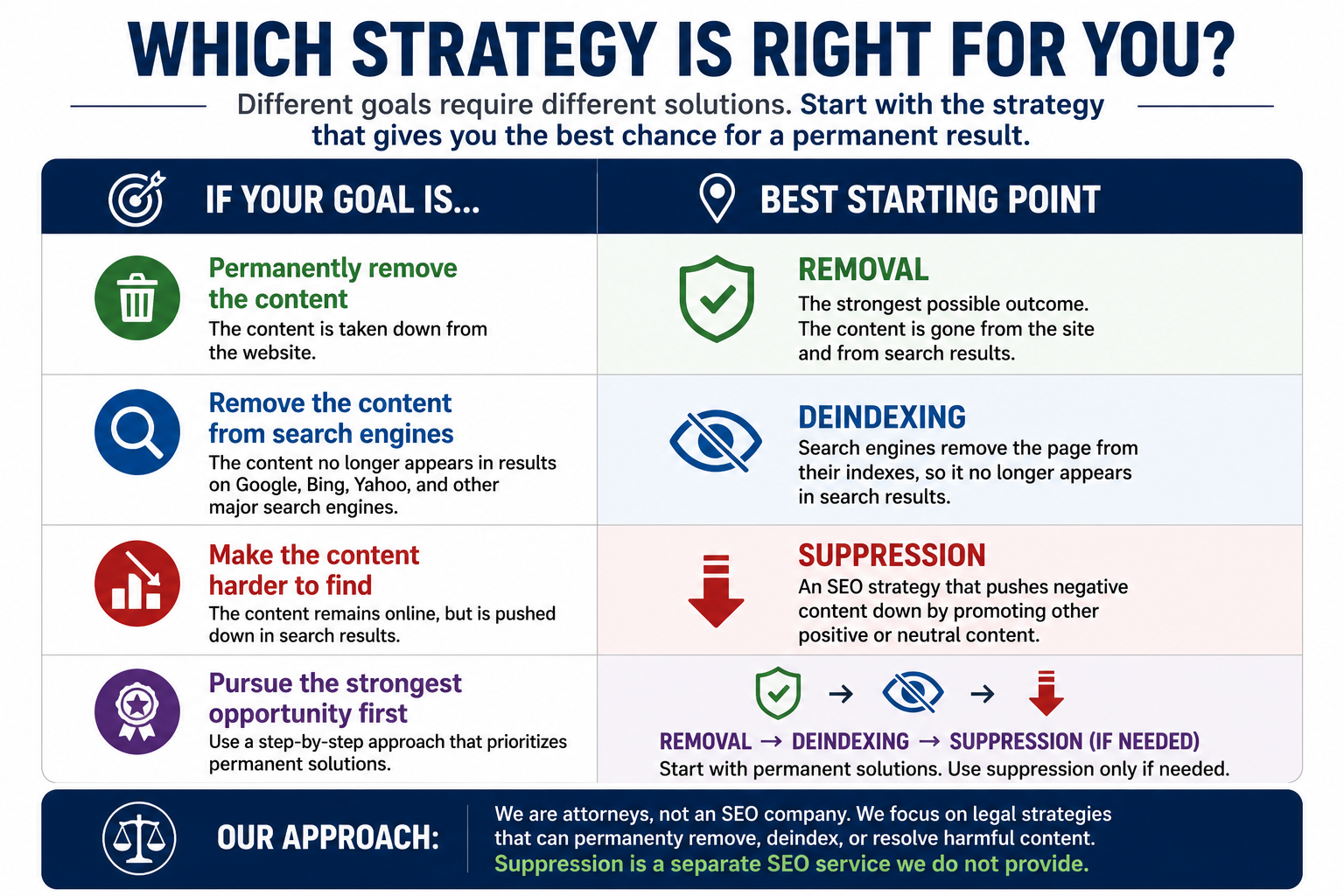
Which Strategy Is Right for You?
Key Takeaway
We don’t view removal and suppression as competing strategies.
We view them as different tools designed to accomplish different goals.
Whenever there’s a legitimate opportunity, we recommend pursuing removal, anonymization, or deindexing first because those strategies attempt to permanently solve the problem.
If those efforts aren’t successful, suppression often becomes an excellent next step to reduce the visibility of whatever content remains.
That’s the philosophy behind our practice.
Is Suppression Ever the Right Choice?
Absolutely. Suppression isn’t a bad strategy. It’s simply a different strategy. We often believe suppression makes sense when the publisher refuses removal, deindexing isn’t available, time-sensitive reputation management is needed, or a client chooses to pursue both strategies simultaneously. Suppression has an important place. We simply don’t believe it should usually be Plan A.
Can You Pursue Both at the Same Time?
Sometimes. Certain clients choose to begin suppression immediately while our attorneys simultaneously pursue removal or deindexing. This dual strategy approach may make sense when an important job opportunity is approaching, a professional licensing decision is imminent, a business launch is approaching, or immediate reputation management is critical. Every case is different. We’ll discuss whether a dual strategy makes sense during your consultation.
Which Strategy Is Right for You?
| If your goal is… | Best Starting Point |
|---|---|
| Permanently solve the problem | Removal |
| Remove your name from Google | Deindexing |
| Improve search rankings | Suppression |
| Pursue the strongest opportunity first | Removal → Suppression if needed |
Key Takeaway
We don’t believe removal and suppression are competing strategies. We believe they’re often sequential strategies. Whenever there’s a legitimate opportunity, we recommend pursuing permanent removal first. If that isn’t successful, suppression often becomes an excellent next step. That’s the philosophy behind our practice.
Continue Exploring
👉 Content Removal Lawyers
📖 Complete Guide to Content Removal
📚 Content Removal Resource Center
❓ Frequently Asked Questions
📅 Schedule a Free Consultation
Related Articles
- What Is Deindexing—and Why It’s One of the Best Outcomes You Can Get
- Flat-Rate vs. Hourly Retainers: Why NSLF’s Refund Model Is Different
- Why You Should Hire a Lawyer—Not a Reputation Management Company
- The Dual Strategy Approach: Pursuing Both Content Removal and Suppression at the Same Time
- Why Google Won’t Remove Your Article—and What You Can Do Instead