
If you’ve started researching online reputation repair, you’ve probably noticed something. Some companies call themselves reputation management companies. Others are law firms that focus on content removal. At first glance, they may appear to offer the same service. They don’t. In fact, they’re solving two very different problems. Understanding that difference can help you decide which type of professional is best suited for your particular situation.
In this guide, we’ll explain what a reputation management company does, what a content removal lawyer does, when each approach makes sense, and why we believe legal advocacy is often the better place to start whenever there’s a legitimate opportunity for permanent removal.
Different Professionals Solve Different Problems
One of the biggest misconceptions about online reputation management is that lawyers and reputation management companies do the same work. They don’t.
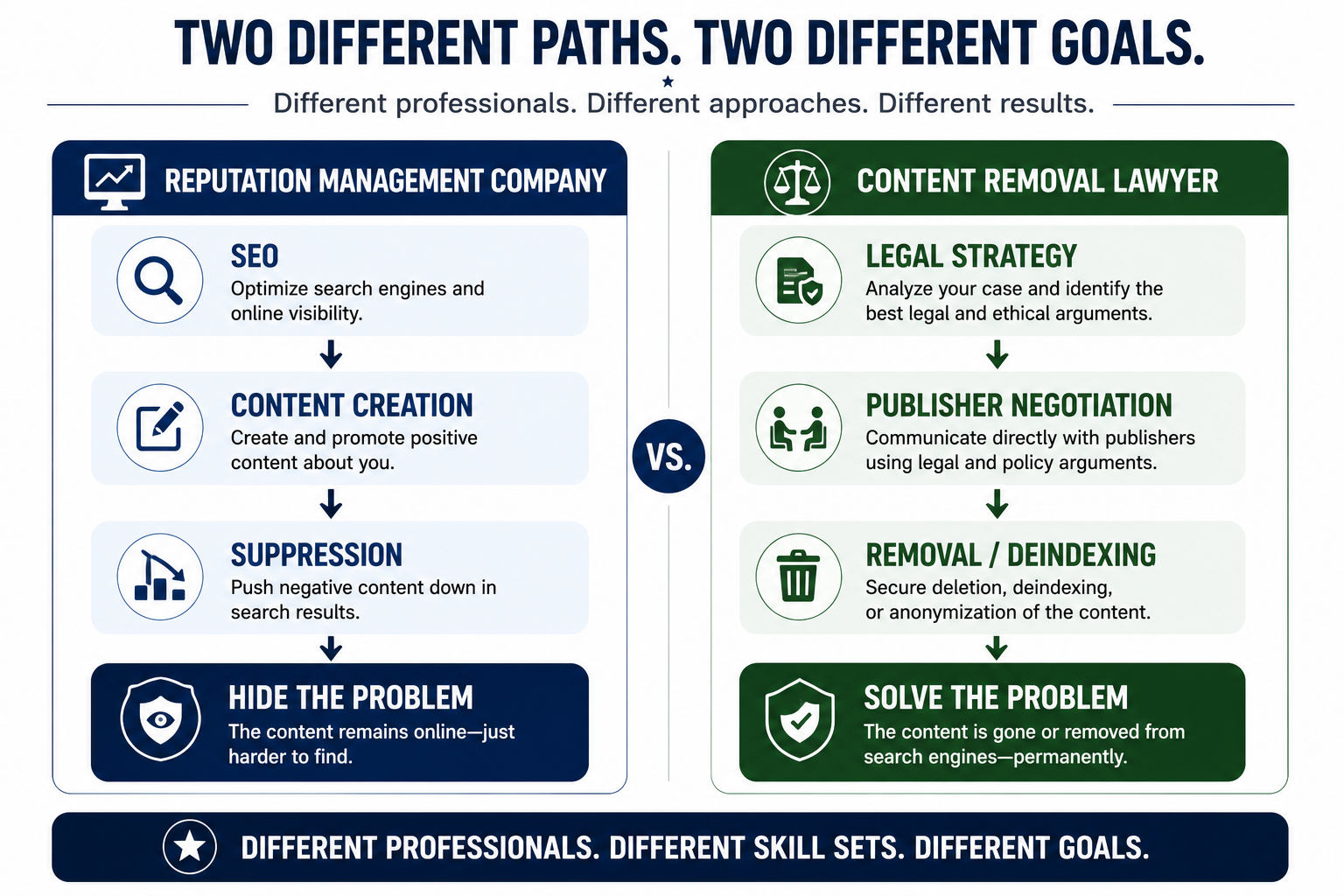
Generally speaking, reputation management companies focus on search engine optimization (SEO), creating positive online content, building websites and profiles, improving search rankings, and suppression. Their goal is to make negative content less visible.
By contrast, content removal attorneys focus on removing articles, negotiating with publishers, pursuing deindexing, pursuing anonymization, developing legal and policy arguments, and advocating for voluntary removal. The goal isn’t to improve search rankings. The goal is to permanently solve the problem whenever there’s a legitimate opportunity.
Neither profession is inherently better. They’re simply solving different problems.
Why We Believe Clients Should Usually Start with a Lawyer
Whenever there’s a legitimate opportunity to permanently remove, anonymize, or deindex content, we believe that’s where clients should begin. Here’s why. If removal is successful, you’ve permanently solved the problem. If it isn’t, suppression remains available. The reverse isn’t true. If you begin with suppression, you’ll never know whether permanent removal was possible.
That’s one of the reasons we’ve structured our practice differently. If we’re unsuccessful under the terms of our representation agreement, we refund our legal fee in full. That allows clients to pursue the strongest possible opportunity first without permanently risking the money they invested in trying.
Lawyers Bring a Different Skill Set
At the end of the day, content removal is about persuasion. You’re asking another person—a publisher, editor, website owner, or decision-maker—to voluntarily remove or deindex content they generally have no legal obligation to remove. That’s different from search engine optimization. Our attorneys evaluate publisher policies, the underlying facts, expungements, rehabilitation, privacy concerns, ethical considerations, fairness arguments, newsworthiness, and available legal arguments.
Every publisher is different. Every client is different. Every strategy is different. There is no template. There is no magic letter. There is only thoughtful legal advocacy tailored to the particular publisher and the particular client.
Can Reputation Management Companies Remove Articles?
Sometimes. Some companies also submit removal requests. Others focus almost entirely on suppression. The important question isn’t “Can they?” The better question is: “Is permanent removal actually the primary service they provide?” If your goal is permanent removal, make sure the professional you’re hiring actually focuses on that type of work.
When a Reputation Management Company May Make Sense
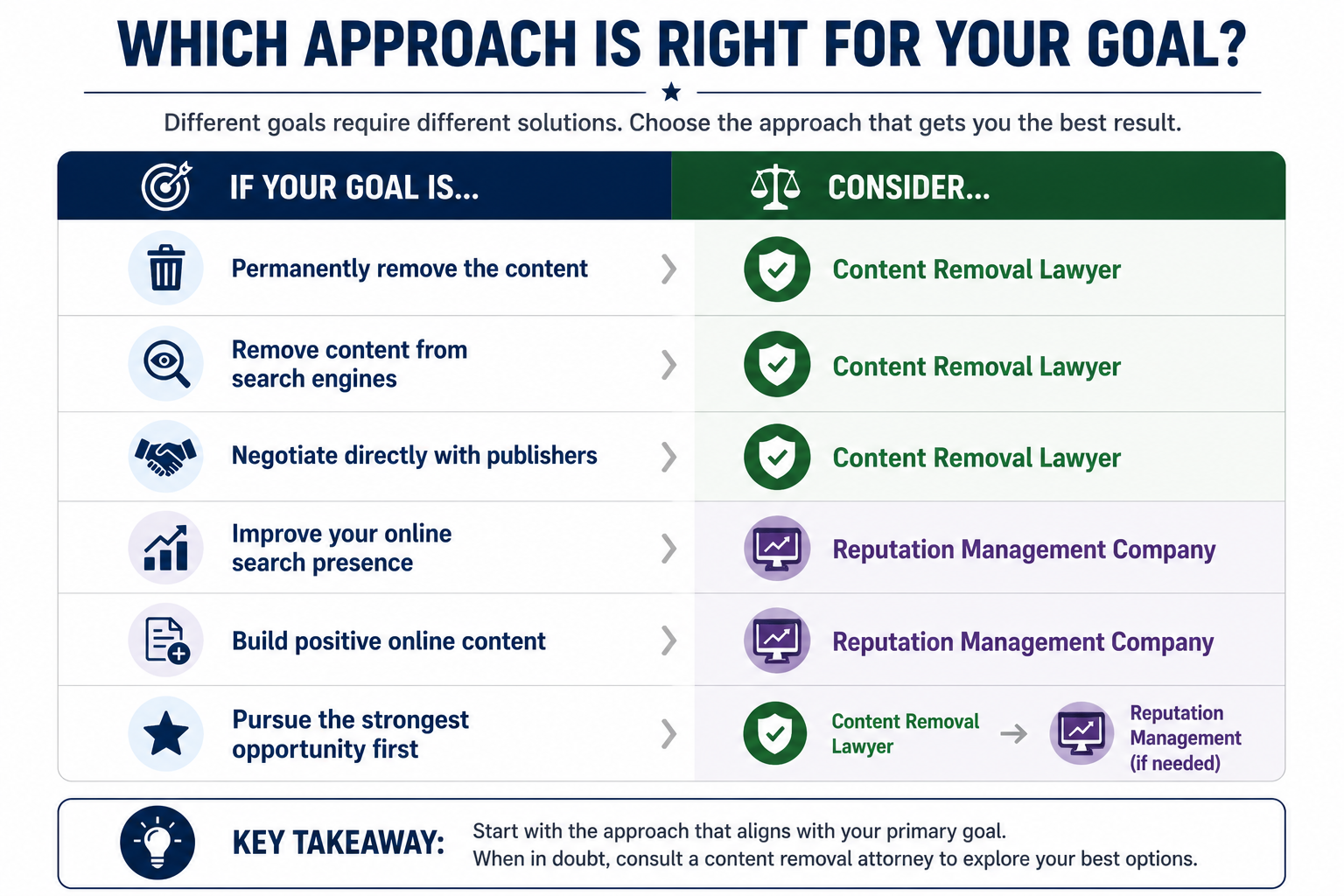
Reputation management companies have an important role. For example, suppression may be appropriate when removal isn’t possible, immediate reputation management is needed, a client wants to build a stronger online presence, or ongoing SEO services are desired. We simply believe those services are often most valuable after you’ve explored the possibility of permanent removal.
Which Professional Is Right for You?
Key Takeaway
Lawyers and reputation management companies aren’t competitors. They’re different professionals performing different work. Whenever there’s a legitimate opportunity to permanently solve the problem, we believe clients should begin with legal removal. If that isn’t successful, reputation management often becomes an excellent next step.
Continue Exploring
👉 Content Removal Lawyers
📖 Complete Guide to Content Removal
📚 Content Removal Resource Center
❓ Frequently Asked Questions
📅 Schedule a Free Consultation
Related Articles
- Removal vs. Suppression: Which Strategy Should You Choose?
- What Is Deindexing—and Why It’s One of the Best Outcomes You Can Get
- The Dual Strategy Approach: Pursuing Both Content Removal and Suppression at the Same Time
- Flat-Rate vs. Hourly Retainers: Why NSLF’s Refund Model Is Different
- How the Content Removal Process Works