
Curious if you’re eligible for Global Entry?
Don’t guess—find out instantly!
Wondering if you can fight your Global Entry denial or revocation? Take our quick assessment to see!
Denied or Revoked from Global Entry? Do Not Rush Into a Weak Appeal.
A Global Entry denial or revocation can be frustrating, especially when CBP provides little explanation beyond a generic statement that you no longer meet the program’s requirements.
The good news is that a denial or revocation does not always mean the end of the road.
Depending on the reason for the decision, you may be able to request reconsideration, obtain additional records, provide mitigation evidence, correct inaccurate information, or otherwise challenge the government’s determination that you are not a low-risk traveler.
The key is understanding what happened before deciding what to do next.
Many travelers make the mistake of immediately submitting a short appeal letter without fully understanding why CBP denied or revoked them in the first place. In some cases, that works. In many cases, however, it results in a missed opportunity to address the actual issue that triggered the decision.
This guide explains the Global Entry appeal process from start to finish, including:
- The two formal redress paths available to travelers
- When records may be needed before filing an appeal
- and
Whether you decide to handle the matter yourself or hire legal counsel, understanding the process is the first step toward making an informed decision. See also: .
Need immediate guidance?
with National Security Law Firm or .
Quick Answer: Can You Appeal a Global Entry Denial or Revocation?
Yes.
Most people refer to the process as an appeal, but the official terms are usually reconsideration or redress.
Under , individuals who are denied membership or removed from the program have two formal methods of seeking review. .
Option 1: CBP Trusted Traveler Ombudsman Reconsideration
The is responsible for reviewing most Global Entry denial and revocation challenges.
This is typically the primary avenue when the issue involves:
- Revocation after prior approval
Option 2: DHS TRIP
is a broader redress system designed for travelers who experience problems related to government screening, identification, or travel-related security concerns.
DHS TRIP may be more appropriate when the issue involves:
- Repeated airport screening or border-crossing difficulties
- Watchlist concerns or misidentification
- Travel delays involving multiple government agencies
Not every case belongs in DHS TRIP, and not every case belongs with the CBP Ombudsman. Choosing the correct path depends on understanding what actually caused the denial or revocation.
Step 1: Understand Why CBP Denied or Revoked You
Before deciding how to respond, you need to identify the issue that likely caused the denial or revocation.
Many applicants are surprised to learn that Global Entry decisions are not limited to criminal convictions. CBP evaluates whether an applicant qualifies as a low-risk traveler under , and the agency has broad discretion when making that determination.
Criminal History
A denial can be triggered by arrests, convictions, pending charges, outstanding warrants, , or .
Many travelers assume that a dismissed or expunged case should not matter. That is not how CBP evaluates risk.
Customs and Border Violations
Issues may include undeclared merchandise, currency reporting violations, , duty-related issues, or prior customs penalties. Even incidents that seem minor can create concerns about future compliance.
Immigration Issues
Certain immigration-related matters can trigger denial or revocation, including prior immigration violations, visa issues, inadmissibility concerns, and waivers.
Application Disclosure Problems
Many denials stem from incomplete or inaccurate application answers — failing to disclose an arrest, forgetting an old charge, omitting foreign travel information, or providing incomplete personal history. CBP treats candor issues seriously.
Association-Based Concerns
In some cases, the denial is not based on the applicant’s conduct alone. CBP may have concerns relating to family members, associates, addresses, travel companions, or certain organizations.
Travel-Based Concerns
Travel history occasionally becomes a factor where CBP believes additional review is warranted based on destinations, frequency, or related circumstances.
Unexplained Denials
Some denial notices provide little meaningful information beyond a statement that the applicant does not satisfy program requirements. | |
Step 2: Determine Whether You Need More Information Before Appealing
One of the biggest mistakes travelers make is assuming they already know why they were denied.
A denial notice may reference only a broad concern — “criminality,” “customs violation,” “program eligibility,” or “failure to satisfy requirements” — without telling you which incident caused the problem, whether government records are accurate, or whether a misunderstanding exists.
Before preparing a full appeal, ask yourself:
Do I know exactly why I was denied?
If yes, you may be ready to move directly into the . If no, additional investigation may be necessary first. — understanding where you are in the process helps determine the right next step.
Are my records complete?
Many travelers no longer have court dispositions, , customs records, or immigration records — all of which may be critical to a successful appeal.
Could government records be inaccurate?
Errors happen. Records may be incomplete, outdated, duplicated, or attributed to the wrong individual. In those situations, obtaining additional information before filing can make a significant difference.
Information-Gathering Options
Enrollment Centers and CBP Information Center
Enrollment Centers and the CBP Information Center can sometimes provide useful context or guidance regarding a denial or revocation.
In certain cases, obtaining government records through a FOIA or Privacy Act request may help identify the basis for a denial or revocation before the appeal is drafted.
FOIA is not necessary in every case. In other cases, records can be essential — a strong appeal should address the actual issue, not a guess about what the issue might be. |
Step 3: Choose the Correct Appeal Path
Once you understand the likely reason for the denial or revocation, the next step is determining the appropriate path for reconsideration or redress.
Many travelers assume there is only one appeal process. In reality, there are multiple ways to address a Global Entry denial depending on the nature of the issue. The right path depends on what caused the problem.
Option 1:
For most Global Entry denials and revocations, the primary path is a reconsideration request through the CBP Trusted Traveler Ombudsman.
This is generally the appropriate option when the denial involves:
- Revocation after prior approval
- Most standard eligibility disputes
The Ombudsman reviews the submission and determines whether reconsideration is appropriate based on the totality of the circumstances.
A strong reconsideration package should do more than simply ask CBP to change its mind. It should explain the issue, address the government’s concern, provide supporting records, and demonstrate why the traveler should still be considered low risk.
Option 2:
The serves a different purpose. It is designed for travelers who experience broader travel-screening or identification issues, and may be appropriate when the issue involves:
- Repeated airport screening or frequent secondary inspections
- Misidentification or watchlist-related concerns
- Border-crossing issues involving multiple agencies
- Travel delays that extend beyond Global Entry membership
In some situations, DHS TRIP and a Global Entry reconsideration strategy may overlap. The key is understanding whether the problem is primarily a Trusted Traveler Program issue or a broader government-screening issue.
Which Option Is Right for You?
| Situation | Typical Next Step |
|---|---|
| Revocation after years of membership | |
| , possible FOIA, then | |
| Repeated airport screening problems | |
| Possible watchlist issue | |
| Possible misidentification issue | |
| Government record concerns |
This chart is only a general guide. Some cases fit neatly into one category. Others require a more customized strategy. for a direct assessment of your situation.
Common Mistake: Choosing a Path Before Understanding the Problem
One of the most common mistakes we see is filing an appeal immediately after receiving a denial without first understanding why CBP made the decision.
The strongest appeals are built around the issue that triggered the denial — not around assumptions about what the issue might be. That is why many successful appeals begin with before the appeal is ever drafted.
Step 4: Gather the Records and Evidence
Once the likely issue has been identified and the proper appeal path selected, the next step is gathering the records needed to support the appeal.
A surprising number of travelers submit appeals without obtaining the records necessary to explain what happened, prove the outcome of a case, correct inaccurate information, or provide mitigation evidence.
The government already has information about you. Your appeal should help put that information into context.
What Records May Be Needed?
The answer depends on the type of denial.
Court Records
If the denial involves , relevant records may include certified court dispositions, dismissal orders, , diversion program records, probation completion documents, fine payment receipts, and sentencing records. A criminal case that ended favorably may still appear in government databases — the appeal should include proof of the final outcome.
If the denial involves a or , supporting records may include penalty notices, warning letters, customs documentation, seizure records, resolution paperwork, and proof of compliance.
For immigration-related denials, records may include visa records, immigration decisions, naturalization records, waiver approvals, and status documentation.
In certain situations, obtaining government records through a may be necessary before preparing the appeal. These records may help identify what agency generated the concern, whether information is inaccurate or incomplete, or whether records have been confused with another individual.
Not every case requires FOIA. Some absolutely do.
Supporting Evidence Matters Too
A strong appeal is rarely built solely on government records. Mitigation evidence is often equally important. Depending on the circumstances, useful supporting evidence may include character reference letters, employment verification, professional licenses, military service records, security clearance history, travel necessity evidence, rehabilitation evidence, and compliance records.
The goal is not simply to explain what happened. The goal is to demonstrate why the issue does not make the traveler a current risk.
Who Gathers the Records?
If a client already has the necessary records, we review and organize them. If records are missing, we help identify what is needed and work to obtain available records whenever possible — including court records, criminal-history records, CBP records, , and supporting documentation. .
The Record Controls the Appeal
No amount of persuasive writing can overcome missing records, inaccurate information, or unsupported claims. Strong appeals are built on facts. The better the records, the stronger the foundation for the appeal.
Step 5: Prepare the Appeal Package
Once the records have been gathered and the likely reason for the denial or revocation has been identified, the next step is preparing the actual appeal package.
This is where many Global Entry appeals are won — or lost.
A surprising number of travelers submit a short statement that simply asks CBP to reconsider. In straightforward situations, that may occasionally work. But in more serious cases, the appeal often needs to do much more.
The goal of the appeal is not simply to tell your story. The goal is to answer the question CBP is really asking:
Why should this traveler still be considered a low-risk traveler despite the issue that led to the denial or revocation?
A strong appeal should make the government’s job easier by presenting the relevant facts, records, mitigation evidence, and supporting documentation in a clear and organized way.
What Makes a Strong Global Entry Appeal?
Strong appeals typically do several things well.
They Identify the Actual Issue
Many unsuccessful appeals never address the real concern. The traveler may focus on why they deserve Global Entry while CBP is focused on something completely different. Before drafting begins, the issue should be identified as clearly as possible.
They Address Risk Directly
Global Entry is a risk-based program. A successful appeal usually explains why the issue does not make the traveler a current risk. For example:
- An may not reflect current behavior
- A may have been isolated and corrected
- An may have been an honest mistake
- A may not reflect actual misconduct
The appeal should connect the facts to the low-risk traveler standard.
They Include Supporting Evidence
Unsupported statements rarely carry much weight. Whenever possible, important claims should be supported by records, documentation, or other evidence.
They Address Mitigation
Mitigation explains why the issue should not control the outcome. Examples may include passage of time, rehabilitation, compliance with court requirements, employment history, military service, professional responsibilities, character references, travel history, and lack of repeated incidents.
They Are Organized
The reviewer should not have to guess what matters. Strong appeal packages present the facts in a logical and easy-to-follow format.
What Does an Appeal Package Actually Look Like?
Many people imagine a Global Entry appeal is a one-page letter. In reality, a serious appeal package is often much more substantial. Depending on the circumstances, a package may include a written appeal memorandum, relevant legal argument, background and procedural history, court records, customs records, immigration records, reference letters, employment documentation, travel-related evidence, supporting exhibits, and an exhibit index. In more complex cases, supporting exhibits alone may exceed twenty or thirty pages.
The goal is not volume for the sake of volume. The goal is to provide a complete picture of the facts and allow the reviewer to evaluate the case efficiently.
Common Appeal Themes
Every case is different, but successful appeals often emphasize one or more of the following.
- The incident was isolated
- The incident occurred many years ago
- There is no pattern of similar behavior
- The traveler has complied with all legal requirements
- The traveler disclosed the issue honestly
- The traveler corrected inaccurate information
- The government records are incomplete or misleading
- The traveler has demonstrated reliability and responsibility since the incident
- The traveler presents little or no future risk
Common Mistakes That Hurt Appeals
Filing Too Quickly
Many travelers submit an appeal before obtaining records or . The appeal then addresses the wrong issue entirely.
Guessing at the Reason
Appeals built on assumptions often miss the actual concern.
Minimizing the Problem
Statements such as “it was only a misdemeanor” or “it was just one mistake” rarely help. CBP already knows what happened. The better approach is to acknowledge the issue and explain why it should not control the outcome today.
Submitting Incomplete Records
Missing court dispositions, customs documents, or supporting evidence can undermine an otherwise strong appeal.
Failing to Address Risk
Global Entry appeals are ultimately about risk. A submission that never addresses why the traveler should still be considered low risk may miss the most important issue.
What We Do in a Global Entry Appeal
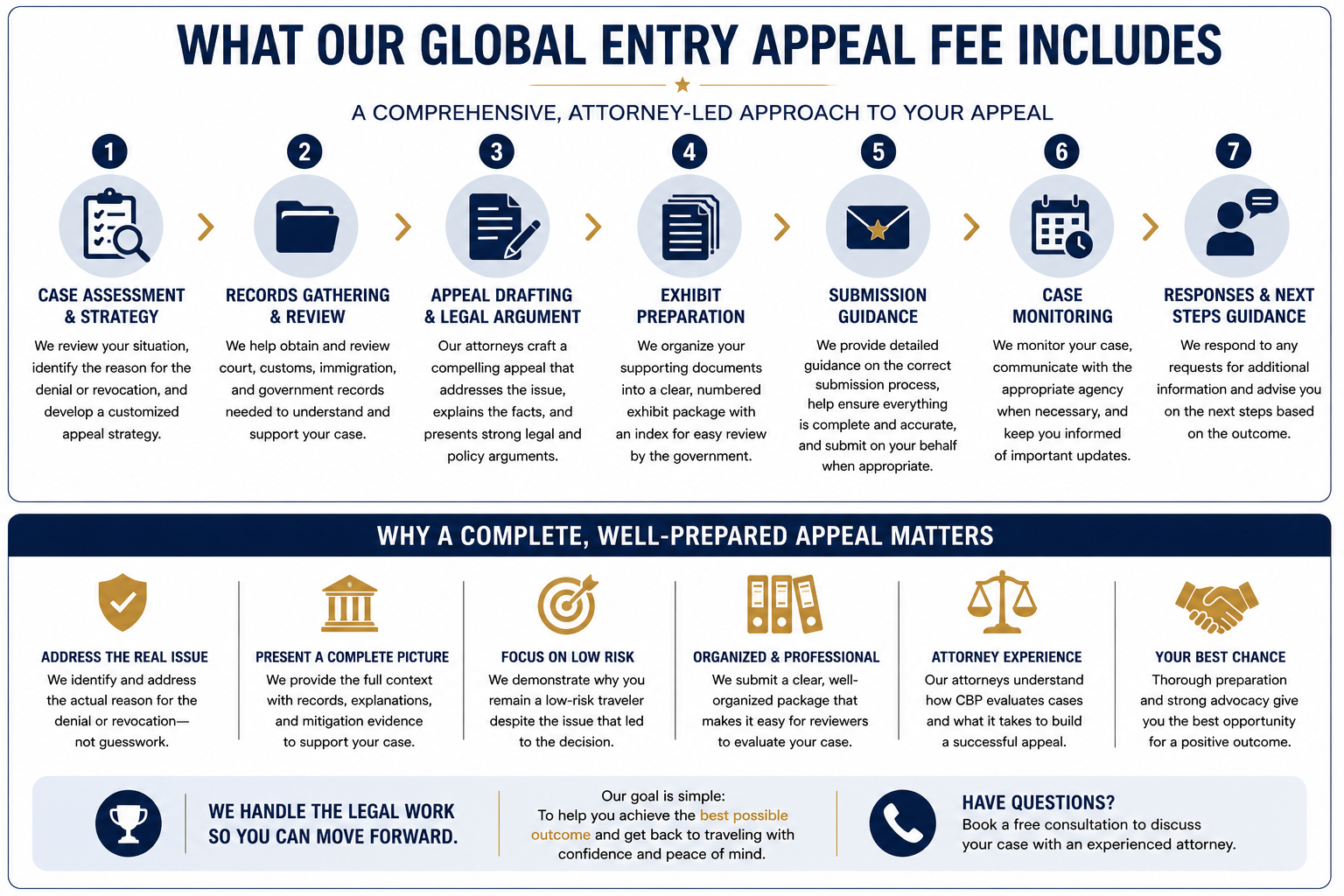
When National Security Law Firm accepts a Global Entry appeal, we do not simply submit a short online explanation. Depending on the circumstances, our work may include: case assessment and strategy, records gathering, court-record review, , mitigation development, reference-letter guidance, attorney-drafted appeal arguments, exhibit organization, and submission guidance.
Step 6: Submit the Appeal
Once the appeal package has been completed, the next step is submitting it through the appropriate reconsideration or redress process.
The correct submission path depends on the type of issue involved and whether the case is proceeding through:
- Another approved review process
At this stage, consistency becomes critical. The appeal should be complete, accurate, include supporting documentation, address the actual issue, and present a consistent explanation throughout. Contradictory explanations, missing records, or last-minute changes can undermine credibility.
For that reason, many travelers spend significant time preparing the appeal package before anything is submitted. Once submitted, the matter enters the government’s review process. |
Step 7: Wait for Review
After the appeal has been submitted, the case enters the government’s review process. This is often the most frustrating stage because there is very little the traveler can do other than wait.
Many people expect a decision within a few weeks. Unfortunately, Global Entry reconsideration requests do not operate on a fixed timeline. The amount of time required depends on the complexity of the issue, whether criminal, customs, immigration, or other records must be reviewed, the volume of appeals currently pending, whether additional government agencies are involved, whether the government requests additional information, and whether the matter involves a simple denial or a more complicated revocation.
|
Can You Expedite a Global Entry Appeal?
This is one of the most common questions we receive. The honest answer is: usually not.
No lawyer can force CBP to review a case faster. No attorney has the ability to move your appeal to the front of the line. No legitimate lawyer should promise to “expedite” a Global Entry reconsideration request.
What an attorney can do is ensure that the appeal is complete, properly documented, and submitted in the strongest possible form from the beginning. Sometimes delays occur because records are missing, explanations are incomplete, or the government requires additional information. A well-prepared appeal may reduce the likelihood of those avoidable delays.
What Should You Do While Waiting?
Generally speaking:
- Monitor your for status updates
- Watch for any requests for additional information from CBP
- Keep copies of everything submitted
- Notify the government of any address or contact-information changes
- Avoid submitting multiple inconsistent explanations
Most importantly, resist the temptation to submit repeated follow-up messages that do not add anything new to the record.
Step 8: Understand the Possible Outcomes
Not every successful appeal looks the same. Many travelers assume there are only two outcomes — approved or denied. In reality, several different outcomes are possible.
Appeal Granted
The government agrees with the appeal and overturns the denial or revocation. Depending on the circumstances, this may result in approval, reinstatement, or the ability to continue the enrollment process.
Membership Reinstated
For previously approved members whose status was revoked, the government may restore membership.
Conditional Approval
In some situations, the appeal may allow the traveler to continue the application process rather than granting immediate approval. This can include conditional approval, , or additional enrollment steps.
Request for Additional Information
Occasionally, the government may seek clarification or additional documentation before making a final decision.
Appeal Denied
The government may sustain the original denial or revocation. This does not necessarily mean all options have been exhausted, but it does mean the traveler must carefully evaluate what comes next. .
A Successful Outcome Does Not Always Mean Immediate Approval
Depending on the stage of the process, success may mean approval, reinstatement, conditional approval, permission to proceed to interview, or reopening of the application. The important question is whether the appeal successfully moved the case forward.
Step 9: What If the Appeal Is Denied?
A denied appeal can be discouraging. However, a denial does not always mean the matter is permanently closed. The appropriate next step depends on why the appeal failed.
Review What Happened
Before taking further action, determine: what issue remained unresolved, were important records missing, was new information needed, was the denial based on inaccurate records, and did the appeal address the actual concern. Understanding why the appeal failed is often more important than immediately filing another request.
Consider Whether New Evidence Exists
Additional evidence may change how the government views the case. Examples may include newly obtained , corrected criminal-history records, updated immigration documentation, additional mitigation evidence, reference letters, and documentation showing rehabilitation or compliance.
Consider Whether FOIA Is Appropriate
Some travelers pursue only after a denial because the government’s reasoning remains unclear. Obtaining records may help identify information that was unavailable during the original appeal.
Consider Reapplication
In some circumstances, the best option may be to wait and reapply later — particularly where significant time has passed, additional positive history has accumulated, the original concern has become less relevant, or new supporting evidence exists.
Consider Whether Additional Legal Options Exist
Certain cases raise issues involving administrative error, incorrect records, misidentification, or procedural concerns that may require a more detailed legal analysis. to discuss whether additional options apply to your situation.
Do Not Automatically Assume a Denied Appeal Is the End
The better approach is to evaluate what happened, identify what information is missing, and determine whether additional action is realistically justified.
Do You Need a Lawyer for a Global Entry Appeal?
Not everyone does. Some Global Entry denials involve straightforward issues that a traveler may be able to address without legal representation.
Other cases involve , , , , inaccurate records, revocations after years of approval, or issues that require substantial supporting documentation. The more complicated the issue, the more important it becomes to understand what triggered the denial and how the government is likely evaluating risk.
If you are unsure whether your case warrants legal representation, .
Should You Handle This Yourself or Hire a Lawyer?
Not every Global Entry denial, revocation, or appeal requires legal representation.
Some travelers can successfully handle straightforward issues on their own, particularly when the reason for the denial is clear and supporting records are easy to obtain.
More complicated situations may benefit from legal assistance, especially when the case involves:
- Inaccurate government records
- Prior unsuccessful appeals
National Security Law Firm has handled more than 1,000 Global Entry and Trusted Traveler Program appeal matters since 2017. Our may include:
- Case assessment
- Records gathering
- Mitigation development
- Attorney-drafted appeal arguments
- Exhibit preparation
- Submission guidance
Flat Fee: $2,995
Approved or Reinstated — or Your Legal Fee Back
If National Security Law Firm accepts your matter for full Global Entry/TTP appeal representation and the appeal is not successful, we refund your legal fee under the written terms of the engagement agreement.
Thinking About Hiring a Lawyer?
Frequently Asked Questions
Can I appeal a Global Entry denial?
Yes. Travelers who are denied or removed from Global Entry generally have redress options through the , , or other approved review processes.
Can I appeal without a lawyer?
Yes. Some travelers successfully pursue reconsideration on their own, particularly when the issue is straightforward and well documented.
How long does a Global Entry appeal take?
There is no guaranteed timeline. Processing times vary depending on the issue, the records involved, and government workload. .
Can a Global Entry appeal be expedited?
Generally, no. No attorney can force CBP to review an appeal faster. .
Should I file a FOIA request before appealing?
Not always. Some cases are clear enough to appeal immediately. Others benefit from obtaining additional records before the appeal is prepared. .
What documents should I include?
That depends on the reason for the denial or revocation. Common documents include court records, customs records, immigration records, reference letters, employment documentation, travel-related evidence, and mitigation materials.
What if my Global Entry was revoked after years of approval?
A revocation can often be challenged, but the appeal should address the issue that triggered the revocation rather than relying solely on prior membership history.
What if my first appeal was denied?
A denied appeal does not always end the process. The appropriate next step depends on why the appeal failed and whether new evidence or records are available. .
What is the difference between DHS TRIP and the CBP Ombudsman?
The generally handles reconsideration requests involving Trusted Traveler Program membership decisions. is broader and may be more appropriate for screening, watchlist, misidentification, or travel-redress issue.
Do I need to know why I was denied before appealing?
Not necessarily, but understanding the reason usually improves the quality of the appeal. In some cases, additional records or may help identify the issue before the appeal is prepared. .
Talk to a Global Entry Appeal Lawyer
If your Global Entry or Trusted Traveler Program membership was denied, revoked, suspended, or not renewed, the most important thing you can do is understand why the decision was made before deciding how to respond.
Some cases are straightforward. Others involve , , , , or that require a more structured approach. National Security Law Firm helps travelers evaluate those situations and determine whether an appeal is worth pursuing.
Not sure what to do next?
An NSLF attorney will review your situation, explain the likely issue, discuss whether additional records may be needed, and give you an honest assessment of your options — at the time you schedule, with no obligation.
Prefer to start on your own? Our free appeal assessment can help you identify potential issues and determine whether a Global Entry appeal may be worth considering.
Related Resources
SECURITY CLEARANCE DENIED OR REVOKED
If you are appealing a security clearance determination, it is imperative that you obtain experienced legal representation. Doing so will provide you with the best opportunity to obtain or maintain your clearance.
Click Here For a No Obligation, Always Confidential Consultation