
A Report of Unfavorable Information (RUI) is one of the least understood—and potentially most damaging—documents in the federal security clearance system.
Many people have never heard of it until years after it has already affected their career.
In fact, one of the most common situations we see at National Security Law Firm looks something like this:
“I left my government job years ago. I recently applied for another cleared position, and the company told me my clearance shows Loss of Jurisdiction. After requesting my records, I discovered my former employer filed a Report of Unfavorable Information that I never knew existed.”
Unfortunately, this happens more often than most people realize.
Many applicants assume that if someone files a report alleging misconduct, they will automatically receive notice, have an opportunity to respond immediately, or at least know that something has been added to their security clearance file.
That is not always how the federal security clearance system works.
Sometimes an RUI is submitted while an employee is still working.
Other times it is filed shortly before a resignation, retirement, military separation, or loss of sponsorship. In many cases, the individual leaves federal service before the matter is fully adjudicated. The clearance is eventually placed into Loss of Jurisdiction (LOJ) status, and the underlying allegations quietly remain inside the person’s security clearance record.
Years later, the issue resurfaces when:
- a new employer attempts to sponsor a clearance
- another federal agency reviews the file
- Continuous Evaluation identifies unresolved concerns
- an investigator reviews prior records during a new background investigation
At that point, applicants are often blindsided.
They are not simply dealing with an old allegation.
They are dealing with a federal record that may have been sitting in the system for years.
Understanding how Reports of Unfavorable Information work is important because an RUI is not a final security clearance decision.
It is often the document that begins the government’s review of whether your eligibility for access to classified information should continue.
And once that information enters your investigative record, it may later influence:
- security clearance investigations
- Continuous Vetting reviews
- Letters of Interrogatory (LOIs)
- Statements of Reasons (SORs)
- Loss of Jurisdiction determinations
- future sponsorship decisions
- reinvestigations
- security clearance appeals
At National Security Law Firm, our attorneys include former security clearance adjudicators, former administrative judges, former DOHA attorneys, and lawyers who have evaluated clearance files from inside the federal system.
One thing becomes clear after reviewing thousands of clearance files:
Many security clearance problems do not begin with a Statement of Reasons.
They begin much earlier—when adverse information quietly enters the investigative record.
This guide explains:
- what a Report of Unfavorable Information is
- who can submit one
- what typically happens after it is filed
- why many people never know one exists
- how it can affect Loss of Jurisdiction and future clearance eligibility
- and what options may exist if the report is inaccurate, incomplete, or based on false allegations.
If you are unfamiliar with how the federal security clearance system operates, we recommend first reviewing our Security Clearance Process guide, which explains how investigations, adjudications, Continuous Vetting, and security clearance records interact throughout the life of a clearance case.
What Is a Report of Unfavorable Information?
A Report of Unfavorable Information (RUI) is a report submitted to security officials when information comes to light that may affect an individual’s continued eligibility to hold a security clearance.
Depending on the agency, similar reports may be called:
- Report of Unfavorable Information (RUI)
- Incident Report
- Adverse Information Report
- Security Incident Report
- Reportable Information
Although the terminology varies, the purpose is generally the same.
The report alerts the government’s security apparatus that new information may require review under the federal security clearance adjudication process.
Importantly, an RUI is not a security clearance denial.
It is not a Statement of Reasons.
It is not a revocation.
And it does not automatically mean you will lose your clearance.
Instead, it is often the first document that places potentially disqualifying information into your federal security clearance record for evaluation.
Think of it as the point where information enters the system—not where the system reaches its final decision.
Once submitted, that information may trigger:
- additional investigation
- interviews
- requests for clarification
- Continuous Vetting review
- adjudicative review
- or, in more serious situations, formal clearance proceedings
That distinction is critical.
Many applicants mistakenly believe that because no formal action occurred immediately, the report “went away.”
In reality, it may simply have remained unresolved inside the federal record until a later event—such as a new sponsorship request or background investigation—caused it to resurface.
This is one reason understanding the difference between an RUI, a background investigation, a Letter of Interrogatory, a Statement of Reasons, and a Loss of Jurisdiction determination is so important.
They are separate stages within the same federal security clearance system—not interchangeable events.
Quick Answer: Can a Report of Unfavorable Information Affect My Security Clearance?
Yes.
A Report of Unfavorable Information can significantly affect both your current and future security clearance eligibility.
Depending on the facts, an RUI may lead to:
- additional background investigation
- Continuous Vetting review
- security clearance interviews
- a Letter of Interrogatory (LOI)
- a Statement of Reasons (SOR)
- temporary suspension
- Loss of Jurisdiction (LOJ)
- denial or revocation of clearance eligibility
- future sponsorship problems
However, filing an RUI does not automatically mean your clearance has been denied.
Nor does it automatically mean the reported allegations are true.
Instead, it means adverse information has entered the federal security clearance system and may now become part of the investigative record that future decision-makers review.
This is one of the most important concepts applicants misunderstand.
The government’s concern is not simply the report itself.
The government evaluates:
- the underlying conduct
- the supporting evidence
- your explanation
- any mitigating information
- your credibility
- and whether the entire record supports continued eligibility under the Adjudicative Guidelines
In other words:
The Report of Unfavorable Information is often where the case begins—not where it ends.
Why Most People Never Know a Report of Unfavorable Information Exists
One of the most frustrating aspects of a Report of Unfavorable Information (RUI) is that many people do not discover it until years after it was submitted.
At National Security Law Firm, we routinely hear versions of the same story:
“I applied for a new cleared position and was told there was a problem with my clearance.”
“My prospective employer said my eligibility showed Loss of Jurisdiction.”
“I filed a Privacy Act request and found a report I had never seen before.”
“I had no idea my former employer reported anything.”
Many people assume that if adverse information is submitted about them, they will automatically receive immediate notice and an opportunity to respond.
That assumption is understandable.
But it is not always how the federal security clearance system operates.
Depending on the circumstances, an individual may:
- resign before the issue is adjudicated
- retire from federal service
- separate from the military
- lose sponsorship
- move to another position
- or simply leave cleared employment altogether
When that happens, the clearance may eventually enter Loss of Jurisdiction (LOJ) status before the underlying concerns are ever formally resolved.
The report itself, however, often remains within the federal security clearance record.
Years later, when another employer attempts to sponsor the individual for a new clearance, the issue may suddenly reappear.
This often surprises applicants because they understandably believe:
- “The issue must have been closed.”
- “Nothing ever happened.”
- “I never received a denial.”
- “No one contacted me.”
But those assumptions can be misleading.
An unresolved Report of Unfavorable Information may continue to influence future investigations, adjudications, sponsorship decisions, and Continuous Vetting reviews long after the original employment relationship ended.
This is one reason Loss of Jurisdiction is frequently misunderstood.
Many applicants believe LOJ means the government determined everything was acceptable.
In reality, LOJ often means something much simpler:
👉 the government lost jurisdiction to continue processing the case because the sponsoring relationship ended.
It does not necessarily mean the reported concerns disappeared.
Nor does it necessarily mean the allegations were investigated to completion.
Instead, the information may remain available for future review if another agency or contractor later sponsors the individual for clearance eligibility.
This is why applicants are often blindsided years later.
The issue is not that something “new” happened.
The issue is that an old record quietly followed them through the federal security clearance system.
If you discover a previously unknown Report of Unfavorable Information, one of the first priorities is determining:
- exactly what was reported
- who submitted the report
- whether any adjudicative action was ever taken
- whether the matter resulted in Loss of Jurisdiction, suspension, or another disposition
- and how that information may affect future sponsorship or clearance eligibility
Understanding those answers is often the first step toward determining what options may still be available.
Who Can Submit a Report of Unfavorable Information?
A Report of Unfavorable Information does not appear in your security clearance file automatically.
Someone has to report information that they believe may affect your continued eligibility to access classified information.
Depending on the agency, that report may originate from:
- your Facility Security Officer (FSO)
- your command security manager
- a military commander
- a federal supervisor
- an agency security office
- an Insider Threat office
- counterintelligence personnel
- another authorized security official responsible for reporting adverse information
It is important to understand what these individuals are—and are not—doing.
Submitting a Report of Unfavorable Information does not mean they are deciding whether you keep your security clearance.
That decision belongs to the appropriate adjudicative authority.
Instead, the person submitting the report is notifying the security system that information exists which may require review.
Sometimes the reported information is:
- accurate
- well-documented
- supported by independent evidence
Other times it may be:
- incomplete
- based on misunderstanding
- unsubstantiated
- one-sided
- factually inaccurate
- or later shown to be incorrect altogether
The person submitting the report is not required to prove that the allegations justify revoking your clearance.
Their responsibility is generally much narrower:
👉 to report information they believe could have security significance.
Once submitted, however, that information enters the federal security clearance process.
Depending on the circumstances, it may later be:
- investigated
- clarified
- corroborated
- challenged
- mitigated
- expanded
- or ultimately rejected
But until that process occurs, the report itself becomes part of your investigative record.
That distinction is critical.
Many applicants assume:
“If someone filed a report, the government must have already concluded I did something wrong.”
That is not how the clearance system works.
A Report of Unfavorable Information is not a finding of misconduct.
It is the beginning of a process—not the end of one.
Unfortunately, because reports frequently become part of a permanent investigative file, they can continue influencing later security clearance reviews even before the underlying allegations have been fully evaluated.
This is one reason understanding what triggered the report in the first place is so important.
The government’s decision is rarely based solely on the existence of the report.
It is based on how the reported conduct is investigated, documented, explained, and ultimately evaluated under the Adjudicative Guidelines.
What Usually Triggers a Report of Unfavorable Information?
A Report of Unfavorable Information is not limited to criminal conduct or obvious security violations.
In reality, almost any information that could reasonably affect a person’s eligibility to access classified information may be reported to security officials for further review.
Sometimes the concern ultimately proves to be significant.
Sometimes it turns out to be minor.
Sometimes it turns out to be entirely unfounded.
The purpose of the report is not to decide the case.
It is to alert the security clearance system that information exists which may require investigation or adjudicative review.
Some of the most common situations that lead to a Report of Unfavorable Information include the following.
Criminal Conduct
Reports are frequently submitted after:
- arrests
- criminal charges
- domestic violence allegations
- assault investigations
- theft accusations
- fraud
- probation violations
- or other law enforcement contact
Importantly, a criminal conviction is not required.
In many cases, the allegation itself is considered reportable until investigators determine how it affects clearance eligibility.
Related resources:
👉 Can You Lose Your Security Clearance for an Arrest?
👉 Can You Lose Your Security Clearance for Criminal Charges?
👉 Guideline J — Criminal Conduct
Drug or Alcohol Issues
Drug- and alcohol-related incidents commonly trigger reports, including:
- positive drug tests
- marijuana use
- illegal drug use
- prescription drug misuse
- DUI arrests
- alcohol-related misconduct
- rehabilitation concerns
- substance-abuse allegations
These reports often raise concerns under:
Related resources:
👉 Can You Lose Your Security Clearance for Drug Use?
👉 Can You Lose Your Security Clearance for Marijuana Use?
👉 Can You Lose Your Security Clearance for Alcohol Abuse?
Security Violations
One of the most common reasons for an RUI is an alleged security violation.
Examples include:
- mishandling classified information
- improper storage of classified material
- unauthorized disclosure
- failing to safeguard sensitive information
- unauthorized removal of protected material
- misuse of classified systems
These allegations frequently involve:
👉 Guideline K — Handling Protected Information
Related resources:
👉 Can You Lose Your Security Clearance for Mishandling Classified Information?
👉 Can You Lose Your Security Clearance for a Security Violation?
Foreign Contacts and Foreign Influence
Foreign relationships are another common source of Reports of Unfavorable Information.
Examples include:
- undisclosed foreign contacts
- foreign romantic relationships
- foreign financial interests
- foreign travel
- foreign business relationships
- dual citizenship concerns
These situations may raise issues under:
Related resources:
👉 Guideline B — Foreign Influence
👉 Can You Lose Your Security Clearance for Foreign Contacts?
Financial Problems
Financial issues may also trigger reporting, particularly where they suggest possible vulnerability or poor judgment.
Examples include:
- significant delinquent debt
- unpaid taxes
- wage garnishments
- bankruptcy
- repeated collections
- unexplained financial problems
These concerns are generally evaluated under:
👉 Guideline F — Financial Considerations
Personal Conduct and Honesty Issues
Some Reports of Unfavorable Information arise because security officials believe an individual may have been less than fully candid.
Examples include:
- omissions on the SF-86
- inconsistent disclosures
- false statements
- failure to report required information
- misleading investigators
- undisclosed outside activities
These reports often become Guideline E — Personal Conduct concerns.
In many cases, the underlying event is not what ultimately damages the clearance.
The issue becomes:
👉 whether the government believes the individual was fully honest about it.
Polygraph Admissions
Some applicants are surprised to learn that information disclosed during a security clearance polygraph may itself become reportable.
Examples include:
- previously undisclosed drug use
- foreign contacts
- criminal conduct
- security violations
- inconsistent prior disclosures
The polygraph does not automatically create the problem.
Instead, the interview often produces new information that enters the investigative record and may trigger additional review.
Related resources:
👉 What Happens If You Admit Something During a Polygraph?
👉 What Happens If You Admit Something During a Polygraph That Wasn’t on Your SF-86?
Workplace Misconduct
Certain employment-related conduct may also lead to reporting.
Examples include:
- insubordination
- misuse of government resources
- workplace violence
- ethics violations
- improper outside employment
- conflicts of interest
- misuse of government computer systems
Depending on the facts, these situations may involve multiple Adjudicative Guidelines simultaneously.
Mental Health or Behavioral Concerns
In some situations, reports are generated because of behavioral incidents that raise concerns about judgment, reliability, or emotional stability.
Importantly, receiving mental health treatment by itself is generally not a basis for filing a Report of Unfavorable Information.
Instead, the concern usually arises when reported behavior—not simply a diagnosis—suggests a possible security issue.
These situations may involve:
👉 Guideline I — Psychological Conditions
Not Every Report Means There Is a Real Security Problem
One of the biggest misconceptions about Reports of Unfavorable Information is that they only involve serious misconduct.
That is simply not true.
Some reports ultimately involve:
- misunderstandings
- incomplete investigations
- isolated mistakes
- unsubstantiated allegations
- factual inaccuracies
- or conduct that is later fully mitigated
Others involve conduct that genuinely raises security concerns.
The important point is this:
The filing of a Report of Unfavorable Information does not determine the outcome of your security clearance case.
It simply begins a process in which investigators, adjudicators, and other decision-makers evaluate whether the reported information actually creates an unresolved national security risk.
That evaluation—and how the information becomes documented in your permanent record—is what ultimately determines whether your clearance remains eligible.
Can a Report of Unfavorable Information Be False?
Yes.
A Report of Unfavorable Information can contain information that is:
- inaccurate
- incomplete
- misleading
- based on misunderstanding
- unsupported by the available evidence
- or, in some cases, entirely false.
This is one of the most important concepts applicants misunderstand.
Many people assume:
“If it made it into my security clearance file, someone must have already determined it was true.”
That is not how the federal security clearance system works.
A Report of Unfavorable Information is not a finding of misconduct.
It is a report that information exists which security officials believe may warrant further review.
Those are two very different things.
In some cases, the report accurately describes serious misconduct.
In others, it may reflect:
- a supervisor’s interpretation of events
- an incomplete investigation
- a misunderstanding of agency policy
- conflicting witness statements
- allegations that were never substantiated
- accusations that were later disproven
- or information that lacked important context
This distinction matters because many people mistakenly focus on proving:
“The report should never have been filed.”
Often, that is not the legal question.
The more important questions become:
- Is the information accurate?
- Is it complete?
- Does the record tell the entire story?
- Has the reported conduct been properly investigated?
- Has subsequent evidence changed how the issue should be viewed?
- Does the record still support treating the issue as a current security concern?
Those are the questions adjudicators ultimately evaluate.
False Report vs. Incomplete Report
Not every problematic Report of Unfavorable Information is intentionally false.
Sometimes the greater problem is that the report tells only part of the story.
Examples include:
- reporting an arrest without noting that charges were later dismissed
- documenting an allegation without recording the investigation’s outcome
- describing an incident before all witnesses were interviewed
- reporting suspected misconduct that was never substantiated
- failing to include corrective action, rehabilitation, or exonerating evidence
When that happens, later decision-makers may be reviewing a record that no longer reflects the full picture.
Because security clearance files are reused over time, an incomplete report can sometimes become almost as damaging as an inaccurate one.
Retaliation and Workplace Disputes
Another situation we occasionally encounter involves allegations that applicants believe were motivated by retaliation or workplace conflict.
For example, applicants sometimes report that adverse information was submitted:
- after filing workplace complaints
- during contentious supervisory disputes
- following disciplinary disagreements
- after resigning unexpectedly
- or shortly before leaving federal employment altogether
Whether retaliation actually occurred is always a fact-specific question.
Simply believing a supervisor acted unfairly does not establish that an RUI was improper.
However, where there is credible evidence that reported information is inaccurate, incomplete, or unsupported, those facts may become highly relevant when evaluating how the report should be interpreted going forward.
For situations where clearance actions may be connected to workplace retaliation, see: How Security Clearances Are Used as Retaliation Against Whistleblowers
The Real Problem Is Often the Record—Not the Report
One of the biggest misconceptions is that the danger lies solely in the filing of the Report of Unfavorable Information.
Often, the greater risk is what happens afterward.
Once adverse information enters your federal security clearance file, it may later be:
- summarized
- referenced during investigations
- compared against future disclosures
- reviewed during Continuous Vetting
- relied upon during adjudication
- and revisited years later during new sponsorship requests
This is why applicants are often surprised when an old report resurfaces long after they believed the matter was over.
The report itself may never have resulted in a formal clearance action.
But the information continued to exist inside the federal record.
That is one of the central principles underlying security clearance law:
The government’s decisions are based not only on what happened—but on what the record says happened.
And once information enters that record, correcting inaccuracies becomes significantly more difficult than preventing them from becoming embedded in the first place.
👉 How to Request a Copy of Your Background Investigation (FOIA or Privacy Act)
👉 The Record Controls the Case: How Security Clearance Files Are Built and Reused
What Happens After a Report of Unfavorable Information Is Filed?
Once a Report of Unfavorable Information is submitted, many people assume an immediate decision will follow.
That is rarely how the security clearance system works.
Instead, the report typically becomes the starting point for additional review.
Exactly what happens next depends on:
- the nature of the reported conduct
- the agency involved
- the available evidence
- whether you still occupy a cleared position
- and whether a sponsoring agency continues to have jurisdiction over your clearance
For some individuals, the report results in little or no additional action.
For others, it becomes the first step in a much larger security clearance case.
A typical progression may look like this:
Report of Unfavorable Information
↓
Security Office Review
↓
Additional Investigation or Fact Gathering
↓
↓
One of Several Possible Outcomes:
- No further action
- Continuous Vetting monitoring
- Letter of Interrogatory (LOI)
- Statement of Reasons (SOR)
- Security clearance suspension
- Loss of Jurisdiction (LOJ)
- Clearance denial or revocation
Not every case follows this exact path.
Some reports are resolved quickly.
Others remain dormant for months—or even years—before resurfacing during a later background investigation or sponsorship request.
That uncertainty is one reason Reports of Unfavorable Information can be so difficult for applicants to understand.
Additional Investigation
In many cases, the report does not immediately result in formal action.
Instead, investigators may seek additional information by:
- reviewing existing investigative records
- interviewing witnesses
- obtaining police or court records
- requesting employment records
- reviewing financial information
- conducting follow-up interviews
- comparing prior security clearance disclosures
The purpose is not simply to verify whether an event occurred.
Investigators are trying to determine whether the reported information creates a current national security concern.
Continuous Vetting
Sometimes an RUI becomes part of your ongoing security clearance history without immediately triggering a formal adjudicative action.
Instead, the information may remain available for future review through Continuous Vetting.
This means the reported issue can later be evaluated alongside:
- new financial information
- arrests
- foreign travel
- subsequent disclosures
- additional reports
- future investigations
Many applicants mistakenly assume that because nothing happened immediately, the report has effectively disappeared.
In reality, it may simply remain part of the federal record until another event causes it to become relevant again.
Letter of Interrogatory (LOI)
If investigators determine additional clarification is needed, the agency may issue a Letter of Interrogatory (LOI).
An LOI gives the applicant an opportunity to explain reported conduct before the government decides whether more formal action is necessary.
The response often becomes a critical part of the permanent security clearance record.
👉 I Received a Letter of Interrogatory — What Should I Do Now?
Statement of Reasons (SOR)
If adjudicators conclude that unresolved security concerns remain, the government may issue a Statement of Reasons (SOR).
An SOR identifies the specific adjudicative guidelines the government believes are implicated and formally explains why your continued eligibility for access to classified information is in question.
At that point, the case has moved well beyond the initial Report of Unfavorable Information.
👉 I Received a Statement of Reasons — What Should I Do?
Suspension or Loss of Jurisdiction
In some situations, particularly when employment or sponsorship ends before adjudication is complete, the case may result in:
Applicants frequently misunderstand Loss of Jurisdiction.
LOJ does not necessarily mean the allegations were resolved.
Often it simply means the government no longer had authority to continue adjudicating the case because the sponsoring relationship ended.
The underlying report may still remain part of the federal security clearance record for future review.
Why This Matters
One of the biggest misconceptions about Reports of Unfavorable Information is that they either “go away” or immediately result in a denial.
Neither assumption is usually correct.
Instead, an RUI often becomes the first document in a chain of events that unfolds over months—or even years.
That is why understanding the next stage is so important.
The report itself rarely determines the outcome.
How the reported information is investigated, documented, explained, mitigated, and ultimately interpreted is what determines whether your security clearance remains eligible.
And once those later records begin to develop, they become increasingly difficult to change.
This is one reason early strategy matters so much.
The Record Controls the Case.
👉 The Record Controls the Case: How Security Clearance Files Are Built and Reused
Here is the section with links embedded from your library:
Can a Report of Unfavorable Information Cause Loss of Jurisdiction?
Yes.
In many cases, a Report of Unfavorable Information is one of the events that ultimately leads to a Loss of Jurisdiction (LOJ) designation.
This is also one of the most misunderstood concepts in the security clearance system.
Many applicants believe that because they never received a clearance denial or Statement of Reasons, the reported issue must have been resolved.
That is often not what happened.
Instead, the sequence may look something like this:
Report of Unfavorable Information
↓
Additional review begins
↓
Employment ends or sponsorship is withdrawn
↓
The government no longer has jurisdiction to continue adjudicating the case
↓
At that point, many applicants assume:
- “The case must have been closed.”
- “Nothing happened.”
- “The allegations must have gone away.”
Unfortunately, that assumption is frequently incorrect.
What Loss of Jurisdiction Actually Means
Loss of Jurisdiction is not a finding that the reported allegations were true.
It is also not a finding that they were false.
Instead, it generally means the adjudicative process stopped because the government no longer had authority to continue processing your clearance.
This most commonly occurs when:
- you resign
- you retire
- military service ends
- you leave a defense contractor
- your employer withdraws sponsorship
- or you otherwise leave the position requiring clearance
The government simply no longer has an active clearance relationship to adjudicate.
That is why the case may end administratively without ever reaching a final clearance decision.
Why Loss of Jurisdiction Creates Problems Years Later
Many applicants discover the consequences of Loss of Jurisdiction only after applying for another cleared position.
A prospective employer attempts to sponsor a new investigation.
The agency reviews the existing security clearance record.
Instead of seeing a completed adjudication, reviewers may find:
- an unresolved Report of Unfavorable Information
- investigative material
- adverse information that was never fully adjudicated
- and a Loss of Jurisdiction designation
At that point, the issue often returns.
Not because anything new occurred.
But because the federal record was never fully resolved.
This is why applicants are often surprised when an incident they thought ended years earlier suddenly affects a new job opportunity.
Loss of Jurisdiction Does Not Erase the Underlying Record
This is one of the biggest misconceptions surrounding LOJ.
Loss of Jurisdiction does not automatically remove:
- Reports of Unfavorable Information
- investigative records
- interview summaries
- adverse documentation
- or other materials already contained in your clearance file
Those records frequently remain available for future investigators and adjudicators to review.
When another agency later considers sponsoring your clearance, those earlier records often become part of the new evaluation.
That is one reason we frequently tell clients:
Loss of Jurisdiction is not the end of the record.
In many cases, it is simply the point where the record stops growing—until another clearance opportunity causes it to start growing again.
Why Understanding LOJ Is So Important
Applicants often spend years trying to understand why prospective employers hesitate after seeing a Loss of Jurisdiction designation.
The answer is not necessarily the LOJ itself.
It is often the unresolved record that sits behind it.
Understanding exactly:
- why the Report of Unfavorable Information was filed
- what investigative work occurred
- whether any adjudicative action was ever taken
- and what information remains in the file
is frequently the first step toward determining whether future clearance eligibility can be restored.
That is why Report of Unfavorable Information cases and Loss of Jurisdiction cases are so closely connected.
The issue is rarely just the administrative designation.
It is the federal record that remains underneath it.
And that record continues to matter long after jurisdiction ends.
👉 Loss of Jurisdiction (LOJ) and Security Clearances — Complete Guide
👉 How to Restore Jurisdiction After LOJ
👉 The Permanent Security File: What Happens to Your Clearance Records
What If You Were Never Told About the Report?
One of the most frustrating situations we encounter is when someone discovers a Report of Unfavorable Information years after it was submitted.
The conversation often starts the same way:
“I never knew this existed.”
Sometimes applicants first learn about the report when:
- a prospective employer cannot sponsor their clearance
- a security officer mentions a Loss of Jurisdiction (LOJ)
- a background investigation raises questions about prior allegations
- they receive records through a Privacy Act or FOIA request
- an investigator references events they believed had already been resolved
Naturally, the first reaction is often:
“How could this happen without anyone telling me?”
The answer depends on the circumstances.
There is no single rule requiring that every Report of Unfavorable Information immediately be provided to the subject in every situation.
Sometimes the report becomes part of an ongoing investigation.
Sometimes employment or sponsorship ends before adjudication is complete.
Sometimes the individual separates from federal service before formal clearance proceedings ever begin.
As a result, many people do not discover the existence of the report until years later.
Does Discovering the Report Years Later Mean It Is Too Late?
Not necessarily.
Discovering a Report of Unfavorable Information after several years does not automatically mean there is nothing you can do.
In many cases, the first priority is understanding exactly what exists in the record.
Questions often include:
- What information was actually reported?
- Who submitted the report?
- Was the information investigated?
- Were the allegations ever substantiated?
- Was any formal adjudicative decision issued?
- Was the matter closed because of Loss of Jurisdiction rather than a final clearance decision?
- Does the record accurately reflect what actually happened?
Those answers matter far more than simply knowing a report exists.
Until you understand what the government is actually relying upon, it is difficult to determine the best strategy moving forward.
The First Step Is Usually Obtaining the Record
Many applicants initially know very little about the underlying report.
They may only know:
- a new employer cannot sponsor them
- their clearance reflects Loss of Jurisdiction
- someone mentioned adverse information
- or an investigator referred to prior allegations
Before developing any strategy, it is often necessary to determine what documentation actually exists.
Depending on the circumstances, that may involve obtaining records through:
- the Privacy Act
- the Freedom of Information Act (FOIA)
- agency-specific record requests
- investigative files
- adjudicative records
Only after reviewing those materials can you begin determining:
- whether the report is accurate
- whether important information is missing
- whether mitigating evidence exists
- and whether future clearance eligibility may still be restored
Avoid Guessing About What the Government Has
One of the biggest mistakes applicants make after discovering an old Report of Unfavorable Information is trying to respond before they fully understand the record.
Some people immediately begin writing explanations.
Others start contacting former supervisors or investigators.
Still others assume the report says something it may not actually say.
Those reactions are understandable.
But they are not always strategically helpful.
Before deciding how to address an old Report of Unfavorable Information, it is generally important to understand:
👉 exactly what the government knows,
👉 what it believes happened,
👉 and what evidence actually supports the report.
Without that foundation, it is easy to create new inconsistencies that become part of the record going forward.
The Goal Is Not Simply to Explain the Report
Many people assume the next step is simply writing a better explanation.
Often, the more important objective is much broader.
It is determining whether the federal record accurately reflects:
- the underlying events
- the investigation
- the available evidence
- subsequent developments
- and any mitigating information that may never have been considered
Because ultimately, future adjudicators will not be reviewing your memory of what happened.
They will be reviewing the federal record.
And that is why understanding—and, where appropriate, correcting—that record is often the most important step after discovering a previously unknown Report of Unfavorable Information.
👉 How to Request a Copy of Your Background Investigation (FOIA or Privacy Act)
👉 The Record Controls the Case: How Security Clearance Files Are Built and Reused
👉 Loss of Jurisdiction (LOJ) and Security Clearances — Complete Guide
The Real Danger Is Not the Report—It Is the Record
Most applicants focus on the Report of Unfavorable Information itself.
That is understandable.
It feels like the problem.
But inside the federal security clearance system, the report is often only the beginning.
The greater danger is what happens after the report enters your file.
Once adverse information becomes part of your investigative record, it rarely remains isolated.
Instead, it may be:
- reviewed during future background investigations
- summarized in investigative reports
- referenced during adjudication
- compared against later disclosures
- incorporated into Continuous Vetting
- relied upon during future sponsorship reviews
- and interpreted by people who were never involved in the original events
This is one of the most important realities of security clearance law:
The government does not simply evaluate events.
It evaluates the record describing those events.
The Record Evolves Over Time
A Report of Unfavorable Information is often only the first layer of documentation.
Over time, additional records may be added, including:
- investigator summaries
- witness interviews
- employment records
- security office memoranda
- subject interviews
- Letters of Interrogatory
- Statements of Reasons
- adjudicative decisions
- Continuous Vetting information
Each new document builds upon what already exists.
If the original report contains inaccuracies, incomplete information, or unsupported assumptions, those issues can quietly become embedded throughout the file.
Future reviewers may then rely on those later documents without ever seeing the full context behind the original report.
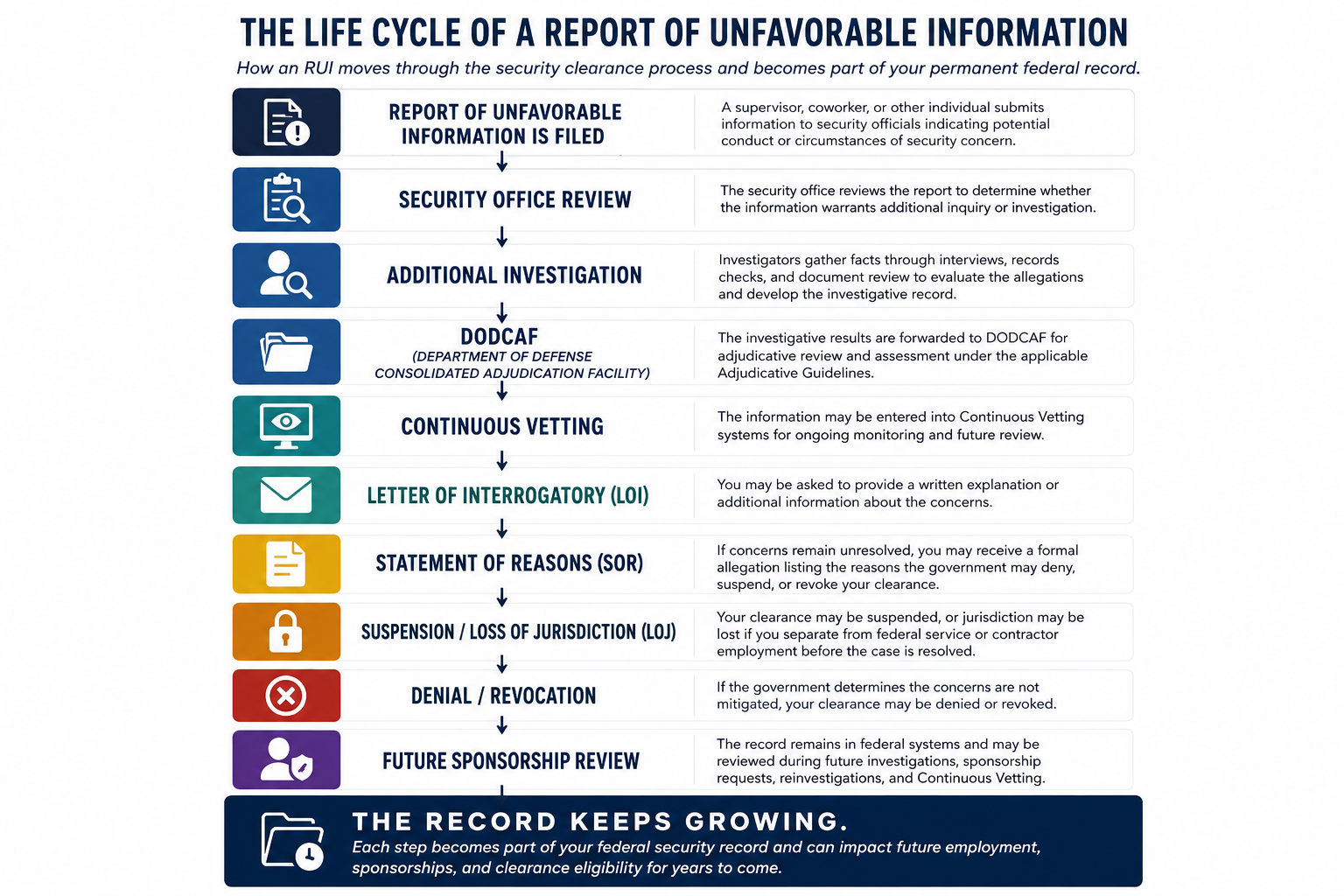
This Is What We Call “Paper Risk”
At National Security Law Firm, we often describe this phenomenon as paper risk.
Paper risk develops when the written record begins creating concerns that extend beyond the underlying event itself.
For example, an isolated workplace incident may eventually become:
- a perceived credibility issue
- a pattern of questionable judgment
- an unresolved security concern
- or evidence of unreliability
Not because additional misconduct occurred.
But because each new document builds upon the language contained in earlier records.
This is why applicants are sometimes surprised to discover that a relatively minor workplace issue has evolved into a much larger security clearance problem years later.
The issue expanded on paper.
Why Early Records Matter So Much
One of the most difficult aspects of federal security clearance cases is that later decision-makers often rely heavily on earlier documentation.
An adjudicator reviewing your file today may never speak with:
- your former supervisor
- the original reporting official
- witnesses
- or anyone involved when the incident first occurred
Instead, they rely on:
👉 the written record.
That means the quality, accuracy, completeness, and context of those early documents may influence clearance decisions years after they were created.
This is one reason we place so much emphasis on record control.
Not because paperwork wins cases.
But because paperwork becomes the lens through which future decision-makers understand the facts.
The Goal Is Not Just to Defend Yourself
Many applicants understandably approach an old Report of Unfavorable Information by asking:
“How do I prove the report was wrong?”
Sometimes that is an important part of the strategy.
But often the larger objective is different.
The real question becomes:
How do we ensure that the federal record accurately reflects what actually happened?
That may involve:
- correcting factual inaccuracies
- supplying missing context
- documenting subsequent developments
- demonstrating rehabilitation
- presenting mitigating evidence
- or clarifying issues that earlier records failed to explain adequately
Because ultimately, future investigators and adjudicators are not deciding your case based on memory.
They are deciding it based on the record.
And that is why one of our core principles remains true throughout every stage of the security clearance process:
👉 The Record Controls the Case: How Security Clearance Files Are Built and Reused
👉 Building a Paper Trail That Survives Government Reuse
👉 How to Command the Record Before the Government Ever Decides
What Adjudicators Actually Care About
One of the biggest misconceptions about Reports of Unfavorable Information is that adjudicators simply ask:
“Was a report filed?”
That is not the question.
A Report of Unfavorable Information may trigger review, but it does not answer the ultimate question every adjudicator must decide:
Is it clearly consistent with the interests of national security to grant or continue this person’s eligibility for access to classified information?
That is a much broader inquiry.
Adjudicators evaluate the entire record—not just the report itself.
Among other things, they consider:
- what actually occurred
- how reliable the available evidence appears
- whether the reported conduct was investigated
- whether the applicant accepted responsibility where appropriate
- whether subsequent evidence changes the significance of the report
- whether any security concerns have been mitigated
- and whether the record, taken as a whole, supports future trustworthiness
This is why two applicants with very similar Reports of Unfavorable Information may receive very different outcomes.
The difference is often not the report.
It is the quality of the record surrounding the report.
Reports Are Evaluated Through the Adjudicative Guidelines
A Report of Unfavorable Information is not evaluated in isolation.
Instead, adjudicators analyze the reported conduct under the applicable Security Clearance Adjudicative Guidelines.
Depending on the allegations, an RUI may implicate:
- Guideline E — Personal Conduct
- Guideline F — Financial Considerations
- Guideline G — Alcohol Consumption
- Guideline H — Drug Involvement and Substance Misuse
- Guideline J — Criminal Conduct
- Guideline K — Handling Protected Information
- Guideline L — Outside Activities
- or several guidelines simultaneously
The report itself does not determine which guideline applies.
The underlying conduct does.
This is one reason applicants are often surprised when a workplace incident ultimately becomes a Guideline E case.
The original allegation may have involved something entirely different.
But once investigators conclude there were inconsistent disclosures, incomplete explanations, or credibility concerns, the focus often shifts toward candor and trustworthiness.
Credibility Often Becomes More Important Than the Original Allegation
Across thousands of security clearance decisions, one pattern appears repeatedly.
The original allegation frequently becomes less important over time.
The government’s attention shifts toward questions such as:
- Was the applicant candid?
- Were disclosures complete?
- Did explanations remain consistent?
- Has the applicant demonstrated sound judgment since the incident?
- Does the record support future reliability?
This is why applicants sometimes lose clearance cases involving relatively manageable underlying conduct.
Conversely, applicants with more serious allegations are sometimes able to retain or regain their eligibility because the overall record demonstrates:
- honesty
- accountability
- rehabilitation
- and long-term reliability
In other words:
👉 adjudicators are not simply evaluating what happened.
They are evaluating what the record now says about your future risk.
The Goal Is to Build a Record That Supports Approval
Ultimately, adjudicators are not looking for perfect applicants.
They are looking for records they can confidently approve.
That means the most important question often becomes:
If another adjudicator reviewed this file five years from now, would the record still support granting this individual access to classified information?
That is why strategy matters.
The strongest clearance cases are not built around arguing with every allegation.
They are built around creating a record that demonstrates:
- credibility
- consistency
- mitigation
- sound judgment
- and future trustworthiness
Because at the end of the process, adjudicators do not approve people.
They approve records.
And in the federal security clearance system:
The Record Controls the Case.
👉 How Security Clearance Adjudicators Actually Think
👉 What Adjudicators Really Look for in a Security Clearance Case
👉 The Whole-Person Concept Explained: Why “Good People” Still Lose Clearance Cases
Real-World Examples: How Reports of Unfavorable Information Affect Security Clearance Cases
Every security clearance case is unique.
The examples below are hypothetical scenarios based on common fact patterns seen in federal security clearance matters. They are designed to illustrate how Reports of Unfavorable Information can affect a case—not to predict the outcome of any particular situation.
Example 1 — The Employee Who Never Knew the Report Existed
A Department of Defense employee resigns after accepting private-sector employment.
Shortly before leaving, the employee’s supervisor submits a Report of Unfavorable Information alleging several security concerns.
The employee is never contacted again.
No Statement of Reasons is issued.
No hearing occurs.
Three years later, the employee accepts another position requiring a security clearance.
The sponsoring contractor discovers the individual’s clearance reflects Loss of Jurisdiction (LOJ) and unresolved adverse information.
The applicant is shocked.
From the applicant’s perspective:
“Nothing ever happened.”
From the government’s perspective:
“The prior concerns were never fully resolved.”
Example 2 — The Incomplete Workplace Investigation
An employee is accused of improperly handling classified material.
The security office files a Report of Unfavorable Information shortly after the allegation is made.
Several weeks later, additional evidence demonstrates the employee did not violate agency procedures.
Unfortunately, the original report remains in the investigative record while the later clarification receives little attention.
Years afterward, a new investigator reviewing the file initially sees the original allegation—but not the full context surrounding its resolution.
This illustrates why incomplete records can become almost as problematic as inaccurate ones.
Example 3 — The Supervisor’s Interpretation
A supervisor reports that an employee displayed poor judgment during a workplace dispute.
The employee strongly disagrees with that characterization.
No criminal charges are filed.
No disciplinary action ultimately occurs.
Nevertheless, the Report of Unfavorable Information documents the supervisor’s version of events.
The question later becomes:
How should future adjudicators interpret competing versions of what happened?
The issue is no longer simply the workplace disagreement.
It is whether the overall record accurately reflects the available evidence.
Example 4 — The False Assumption About Loss of Jurisdiction
A defense contractor loses sponsorship after changing employers.
The clearance enters Loss of Jurisdiction status.
The applicant assumes:
“My clearance must still be fine because it was never denied.”
Several years later, another employer initiates sponsorship.
During the new review, investigators revisit the unresolved Report of Unfavorable Information that preceded the Loss of Jurisdiction designation.
The applicant discovers that LOJ did not erase the underlying security concerns.
It merely paused the adjudicative process.
Example 5 — The Report That Ultimately Did Not Matter
An employee becomes involved in a workplace incident that results in a Report of Unfavorable Information.
Additional investigation later confirms:
- the allegations were largely unsupported
- the employee cooperated fully
- the facts were clarified
- and no ongoing security concern remained
The adjudicator reviews the complete record and determines the reported issue has been fully resolved.
The clearance is maintained.
This illustrates an important point:
A Report of Unfavorable Information does not automatically lead to suspension, denial, or revocation.
The government’s decision depends on the complete investigative record—not simply the existence of the report.
What These Examples Have in Common
Although the underlying facts differ, every example illustrates the same principle.
The Report of Unfavorable Information was only the beginning.
What ultimately mattered was:
- how the issue was investigated
- how the record developed
- whether the reported information proved reliable
- whether mitigating evidence existed
- and whether future adjudicators believed the record supported continued eligibility for access to classified information
That is why successful security clearance cases are rarely won by arguing about a single document.
They are won by understanding—and, when necessary, rebuilding—the record that decision-makers ultimately rely upon.
👉 The Record Controls the Case: How Security Clearance Files Are Built and Reused
👉 How Investigators Build the Record That Leads to an SOR
👉 Loss of Jurisdiction (LOJ) and Security Clearances — Complete Guide
What Should You Do If You Discover a Report of Unfavorable Information?
Discovering a previously unknown Report of Unfavorable Information can be alarming.
For many people, it feels like learning that someone has been writing part of your security clearance story without your knowledge.
The first instinct is often to react immediately:
- contact your former supervisor
- write a lengthy explanation
- demand the report be removed
- or try to explain everything before understanding what actually exists
Those reactions are understandable.
But they are not always the best first step.
In most cases, the better approach is systematic—not emotional.
Step 1: Obtain the Record
Before deciding what to do, determine exactly what the government has.
That may include:
- the Report of Unfavorable Information itself
- investigative reports
- interview summaries
- adjudicative records
- security office memoranda
- related documentation obtained through the Privacy Act or FOIA
Never assume you know what the report says based on what someone tells you.
Read the actual record.
Step 2: Determine Whether the Matter Was Ever Adjudicated
Many applicants discover that:
- no Statement of Reasons was ever issued
- no final adjudication occurred
- the matter ended because of Loss of Jurisdiction
- or the investigation simply stopped when sponsorship ended
Understanding where the process stopped is critical.
The strategy for an unresolved investigation is often very different from the strategy for a completed denial or revocation.
Step 3: Separate Facts From Conclusions
Not every statement in an investigative file is an established fact.
Some entries reflect:
- allegations
- witness statements
- preliminary conclusions
- investigative observations
- or information that was never fully tested
One of the first tasks is identifying:
- what is objectively supported
- what remains disputed
- and what may simply reflect someone’s interpretation
Those distinctions become extremely important during later adjudication.
Step 4: Preserve Supporting Evidence
If the report is inaccurate or incomplete, begin gathering documentation while it is still available.
Examples may include:
- employment records
- court records
- investigative findings
- emails
- personnel documents
- witness statements
- training records
- performance evaluations
- or other materials that provide context
Over time, records disappear, witnesses relocate, and memories fade.
Early preservation of evidence is often much easier than attempting to reconstruct events years later.
Step 5: Think Long-Term—Not Just About the Current Job
Many applicants focus only on the immediate employment opportunity.
But a Report of Unfavorable Information often affects much more than one job application.
Depending on the circumstances, it may later influence:
- future security clearance sponsorship
- Continuous Vetting
- reinvestigations
- federal employment opportunities
- contractor hiring decisions
- promotions into sensitive positions
- or future adjudicative reviews
This is why the objective should not simply be resolving today’s problem.
It should be protecting tomorrow’s record.
The Biggest Mistake We See
The most common mistake is treating the Report of Unfavorable Information as an isolated event.
It isn’t.
It is often one document in a much larger federal record that may continue evolving for years.
Every explanation, correction, disclosure, and future submission becomes part of that same record.
That is why strategy matters.
The goal is not simply to respond to one report.
The goal is to ensure the entire record accurately reflects:
- what actually happened
- how the issue was investigated
- what mitigating evidence exists
- and why future decision-makers should continue to trust you with access to classified information
Because ultimately, security clearance cases are not decided by one document.
They are decided by the record that grows around it.
Related Security Clearance Resources
A Report of Unfavorable Information rarely exists in isolation.
Once adverse information enters the federal security clearance system, it often affects multiple stages of the investigation and adjudication process.
The resources below explain what typically happens next—and how each stage builds upon the last.
Understanding the Security Clearance Process
If you are unfamiliar with how security clearance cases move from investigation to adjudication, start here:
Security Clearance Investigations
Most Reports of Unfavorable Information become part of a broader background investigation.
Learn how investigators evaluate reported information:
👉 Security Clearance Investigations Explained
👉 What Happens During a Security Clearance Investigation?
👉 What Happens If Investigators Find Something Concerning?
Loss of Jurisdiction (LOJ)
Many Reports of Unfavorable Information eventually intersect with Loss of Jurisdiction after sponsorship or employment ends.
Learn more:
👉 Loss of Jurisdiction (LOJ) and Security Clearances
👉 What Is Loss of Jurisdiction?
👉 How to Restore Jurisdiction After LOJ
Continuous Vetting
Even if no immediate action occurs, reported information may later be reviewed through Continuous Vetting.
Learn how ongoing monitoring works:
👉 Continuous Vetting for Security Clearances: How It Works—and Why It Changes Everything
👉 Security Clearance Flagged in Continuous Vetting
Letter of Interrogatory (LOI)
Some Reports of Unfavorable Information eventually result in a Letter of Interrogatory requesting additional explanation.
Learn what that means:
👉 What Is a Letter of Interrogatory?
👉 How to Respond to a Security Clearance Letter of Interrogatory
Statement of Reasons (SOR)
If the government concludes unresolved security concerns remain, the next stage may be a Statement of Reasons.
Learn more:
👉 How to Respond to a Statement of Reasons
Security Clearance Adjudicative Guidelines
Reports of Unfavorable Information are ultimately evaluated under the federal Adjudicative Guidelines.
Explore the complete guide:
👉 Security Clearance Adjudicative Guidelines Explained
The Permanent Record
One of the most important concepts in security clearance law is that investigative records are reused throughout your federal career.
Learn why that matters:
👉 The Record Controls the Case: How Security Clearance Files Are Built and Reused
Requesting Your Security Clearance Records
If you recently discovered a Report of Unfavorable Information—or suspect one exists—you may need to obtain your investigative file before determining the best course of action.
Learn more:
👉 How to Request a Copy of Your Background Investigation (FOIA or Privacy Act)
Can a Report of Unfavorable Information Be Removed?
One of the first questions many people ask after discovering a Report of Unfavorable Information is:
“Can I have it removed from my security clearance record?”
The honest answer is:
Sometimes—but often the better question is whether the record can be corrected, clarified, or placed into proper context.
Many applicants assume there is a formal process for simply deleting unfavorable information.
In reality, the federal security clearance system rarely works that way.
Whether information can be removed depends on many factors, including:
- which agency created the report
- whether the report contains factual inaccuracies
- whether the information has already been incorporated into investigative records
- whether adjudicative action has already occurred
- and what legal procedures are available under the Privacy Act or other applicable authorities
Removal Is Not Always the Most Important Goal
Many applicants become focused on one objective:
“I want this report removed.”
Sometimes that is possible.
But often, the more realistic—and more strategically important—objective is ensuring that future decision-makers review a record that is:
- accurate
- complete
- properly documented
- and supported by all relevant evidence
In other words, the goal is not always to erase the report.
It is to prevent an incomplete or misleading record from becoming the version of events that future adjudicators continue relying upon.
Correction Is Often More Valuable Than Deletion
In many cases, security clearance files evolve over time.
Additional documentation may demonstrate that:
- allegations were never substantiated
- investigations reached different conclusions
- important facts were omitted
- subsequent evidence changed the significance of the original report
- or mitigating information was never included in the original investigative record
Those developments can become extremely important.
Because future adjudicators are generally evaluating the entire record—not a single document viewed in isolation.
Every Situation Is Different
There is no single procedure that applies to every Report of Unfavorable Information.
Some cases involve:
- factual errors
- incomplete investigations
- mistaken identity
- unsupported allegations
- or records that simply lack important context
Others involve conduct that occurred but has since been fully mitigated through:
- rehabilitation
- changed circumstances
- documented corrective action
- or years of reliable service
The appropriate strategy depends on understanding:
- what the report actually says
- what evidence supports it
- what later records exist
- and how the information is likely to be interpreted by future investigators and adjudicators
That analysis is often far more valuable than simply asking whether the report can be deleted.
Because in the federal security clearance system, the objective is not merely to remove unfavorable information.
It is to build a record that future decision-makers can confidently approve.
And that almost always begins with understanding the record that already exists.
👉 How to Request a Copy of Your Background Investigation (FOIA or Privacy Act)
👉 The Permanent Security File: What Happens to Your Clearance Records
👉 How to Command the Record Before the Government Ever Decides
Can a Report of Unfavorable Information Affect Future Jobs?
Yes.
In many cases, the most significant impact of a Report of Unfavorable Information is not what happens immediately.
It is what happens years later.
Many people first discover an RUI only after accepting—or attempting to accept—a new position requiring a security clearance.
The hiring process appears to be moving normally.
Then the employer suddenly says:
- “There appears to be an issue with your clearance.”
- “Your eligibility reflects Loss of Jurisdiction.”
- “We need additional information before sponsorship can continue.”
- “Your prior clearance history requires further review.”
For many applicants, this comes completely out of nowhere.
Nothing new happened.
The underlying incident may have occurred years earlier.
The surprise comes from the fact that the federal record continued to exist long after the original employment relationship ended.
Future Sponsors See More Than Your Current Eligibility
When a federal agency or defense contractor considers sponsoring you for a security clearance, they are not simply asking:
“Does this person currently have a clearance?”
They are often reviewing your broader security clearance history.
That history may include:
- prior investigations
- Reports of Unfavorable Information
- Loss of Jurisdiction determinations
- investigative summaries
- adjudicative actions
- prior Statements of Reasons
- previous security concerns
- and other information contained within your federal security record
This is one reason applicants are often surprised when an issue they believed was resolved suddenly becomes relevant again.
The record follows the individual—not the employer.
Clearance Problems Rarely Stay Isolated
Many applicants understandably think of an RUI as one unfortunate event from a prior job.
The federal government often views it differently.
Once adverse information enters the system, it may influence future decisions involving:
- security clearance sponsorship
- federal employment
- contractor eligibility
- sensitive assignments
- promotions
- transfers to higher levels of access
- and future background investigations
This does not mean an old Report of Unfavorable Information automatically prevents future employment.
Far from it.
Many applicants successfully obtain new clearances after resolving earlier concerns.
But those earlier records often remain part of the evaluation process.
Future Employers May Never Meet the People Who Filed the Report
One of the realities of the federal clearance system is that future decision-makers usually were not present when the original events occurred.
They often never meet:
- your former supervisor
- the reporting official
- witnesses
- or the investigator who handled the original matter
Instead, they rely on:
👉 the written record.
That is why the quality of that record matters so much.
If the record accurately reflects:
- the facts
- the investigation
- mitigating evidence
- and subsequent developments
future adjudicators are far more likely to evaluate the matter fairly.
If the record is incomplete or misleading, however, those same deficiencies may continue following you from one clearance opportunity to the next.
This Is Why Early Record Control Matters
Applicants often ask us:
“Can this old Report of Unfavorable Information still affect my career?”
The answer is often yes.
But the more important question is:
What does the current federal record actually say about me today?
Because future employers are rarely making decisions based on your personal recollection of events.
They are evaluating the investigative record that has accumulated over time.
That is why we consistently emphasize one principle throughout every stage of the security clearance process:
The Record Controls the Case.
And in many situations, it also controls future career opportunities.
Frequently Asked Questions About Reports of Unfavorable Information
What is a Report of Unfavorable Information (RUI)?
A Report of Unfavorable Information (RUI) is information submitted to security officials indicating that conduct or circumstances may affect an individual’s eligibility to hold a security clearance.
An RUI is not a clearance denial, revocation, or finding of misconduct.
Instead, it alerts the security clearance system that additional review may be necessary.
Does a Report of Unfavorable Information automatically mean I will lose my security clearance?
No.
A Report of Unfavorable Information is only one part of the security clearance process.
Many reports never result in suspension, denial, or revocation.
The government ultimately evaluates:
- the underlying facts
- the available evidence
- your credibility
- any mitigating information
- and whether granting or continuing your clearance is clearly consistent with the interests of national security
Can a Report of Unfavorable Information be false?
Yes.
An RUI may contain information that is:
- inaccurate
- incomplete
- based on misunderstanding
- unsupported by evidence
- or, in some cases, entirely false
However, the more important question is often not whether the report exists, but whether the overall investigative record accurately reflects what actually occurred.
Why wasn’t I told that a Report of Unfavorable Information had been filed?
Many applicants assume they will automatically receive notice whenever adverse information enters their security clearance record.
That is not always what happens.
Some individuals leave federal service, retire, resign, separate from the military, or lose sponsorship before the matter is fully adjudicated.
Years later, they first learn about the report when applying for another cleared position or obtaining their records through the Privacy Act or FOIA.
Can a Report of Unfavorable Information lead to Loss of Jurisdiction?
Yes.
If employment or sponsorship ends before the government completes the adjudicative process, the clearance may enter Loss of Jurisdiction (LOJ) status.
This does not necessarily mean the reported concerns were resolved.
In many cases, the underlying investigative record remains available for future review.
Can I obtain a copy of the Report of Unfavorable Information?
Often, yes.
Depending on the circumstances, you may be able to obtain records through:
- the Privacy Act
- the Freedom of Information Act (FOIA)
- agency-specific record requests
Obtaining the complete record is often one of the first steps in determining how the report may affect future clearance eligibility.
Can inaccurate information be corrected?
Sometimes.
Whether records can be corrected depends on:
- the agency involved
- the nature of the information
- the available evidence
- and the procedural posture of the case
In many situations, the goal is not simply removing a document from the file.
It is ensuring that future adjudicators have a complete and accurate record when evaluating your clearance eligibility.
Can a Report of Unfavorable Information affect future security clearance applications?
Yes.
Even if years have passed, the report may later be reviewed during:
- new sponsorship requests
- background investigations
- Continuous Vetting
- reinvestigations
- adjudication of future clearance applications
This is one reason early understanding of the record is so important.
Should I hire a lawyer if I discover a Report of Unfavorable Information?
Not every Report of Unfavorable Information requires legal representation.
However, experienced legal guidance may be particularly valuable when:
- you recently discovered a previously unknown report
- the report appears inaccurate or incomplete
- your record reflects Loss of Jurisdiction
- a new employer cannot sponsor your clearance
- you anticipate a Letter of Interrogatory or Statement of Reasons
- your career depends on obtaining or restoring clearance eligibility
Because Reports of Unfavorable Information often become part of a much larger federal record, early strategic analysis can help prevent manageable issues from becoming significantly more difficult to resolve later.
👉 Do You Actually Need a Security Clearance Lawyer? It Depends on the Stage
Why National Security Law Firm Is Different
Most law firms become involved only after a security clearance has been suspended, denied, or revoked.
At National Security Law Firm, we often begin much earlier.
Many clients come to us after discovering a Report of Unfavorable Information that they never knew existed—or after learning that an unresolved report has resulted in Loss of Jurisdiction, prevented a new employer from sponsoring their clearance, or quietly followed them for years through the federal security clearance system.
Those situations require more than simply responding to an allegation.
They require understanding how the federal record was created in the first place.
Our attorneys include:
- former security clearance adjudicators
- former administrative judges
- former Department of Defense attorneys
- attorneys who have held security clearances themselves
That insider experience matters because we understand how Reports of Unfavorable Information are evaluated—not only when they are first submitted, but years later when they resurface during a new investigation or sponsorship request.
We Focus on the Record—Not Just the Allegation
Many applicants understandably focus on proving that an allegation is false.
Sometimes that is appropriate.
But experienced security clearance representation requires asking a broader set of questions.
For example:
- What information actually entered the federal record?
- How has that information been reused over time?
- Was the matter ever fully investigated?
- Did Loss of Jurisdiction interrupt the adjudicative process?
- Does the current record accurately reflect the available evidence?
- How will a future adjudicator interpret the file as it exists today?
Those questions often determine the future of a clearance case far more than the original report itself.
Every Major Case Is Reviewed Through Our Attorney Review Board
Significant security clearance matters are evaluated through our Attorney Review Board, where multiple experienced attorneys review the record, identify weaknesses, and refine strategy before major submissions are made.
This collaborative approach reflects the reality of the federal security clearance system itself.
Clearance decisions are not made by a single individual.
They involve investigators, adjudicators, administrative judges, and multiple layers of institutional review.
We believe your legal strategy should reflect that same level of analysis.
👉 Why Team-Based Defense Wins More Clearance Cases
Our Goal Is to Build a Record That Can Be Approved
Security clearance cases are not won by making the loudest argument.
They are won by building a record that decision-makers can confidently approve.
That often requires:
- identifying inaccuracies
- supplying missing context
- presenting mitigating evidence
- resolving credibility concerns
- and ensuring the record accurately reflects both the underlying facts and your current reliability
Because at the end of the process, adjudicators are not simply reviewing an allegation.
They are reviewing your federal security clearance record.
And that record may continue following you throughout your federal career.
That is why our approach has always been built around one core principle:
Speak With a Security Clearance Lawyer Before the Record Develops Further
If you recently discovered a Report of Unfavorable Information—or you have learned that an unresolved report has affected your clearance eligibility, sponsorship, or Loss of Jurisdiction status—the next steps matter.
Understanding what is actually contained in your federal security clearance record is often the first step toward protecting your future eligibility.
We represent security clearance applicants, clearance holders, federal employees, military personnel, and government contractors nationwide.
Your consultation is:
- free
- confidential
- and focused on helping you understand how your record is likely to be evaluated moving forward
If representation is appropriate, we also offer:
- transparent flat-fee pricing
- flexible payment options through Pay Later by Affirm
- and strategic guidance designed to protect not only your current clearance issue—but your long-term federal record
Because in the federal security clearance system:
The Record Controls the Case.
👉 Security Clearance Lawyer Free Consultation
👉 How Much Does a Security Clearance Lawyer Cost?
👉 Why National Security Law Firm — Security Clearance Lawyers